Showing posts with label Castles and Crusades. Show all posts

Monday, October 28, 2013

Monster Monday: Mirror Demon

Just in time for Halloween...

Mirror Demon

No. Enc.: 1
Size: Medium
HD: 5 (d12)
Move: 30 ft
AC: 18
Attacks: Grapple (1d6)
Special: Reduced Demon Abilities,
     Mirror Travel, Energy Drain,
     Change Shape, Class Abilities,
     Reflection Weakness
Saves: P, M
INT: High
Align: Chaotic Evil
Type: Extraplanar
TR: Nil (but see below)
XP: 700+5/hp

A mirror demon is a lesser form of True Demon that can travel from the Abyss into the mortal plane via any mirror large enough for to allow their bodies to pass through.  They may take the form of those they kill, and they greatly enjoy creating havoc and discord among the family and friends of their victims.  They prefer to target the vain and beautiful (the types of people prone to stare at themselves in a mirror extensively).  In their true form, their skin is pale (almost corpse-like), with jet-black eyes that cry tears of blood.

A mirror that a Mirror Demon has recently used to travel through, or observe their potential victims, will glow faintly of demonic magic if subjected to a Detect Magic or Detect Evil spell.

Although the demons have no treasure themselves, their victims are often wealthy (the poor being highly unlikely to own a mirror large enough that the demon could pass through).

Combat: A mirror demon will usually wait until their victim is alone in whatever room the mirror is in, with their guard down, before traveling through the mirror to attack.  They will grapple (literally trying to to choke the life out of their victim), with successful attacks also leading to the victim being Energy Drained (see below).

Reduced Demon Abilities: Mirror Demons have the following standard demonic abilities: Darkvision 90', immunity to electricity & poison, and taking only half damage from acid, cold, & fire.  They also have a spell Resistance of 20, and the standard demonic empathy/telepathy which allows them to learn the thoughts, and speak any language known, of their victim, although they must observe their victim at least three times within a week's span through a mirror before this last ability is granted.

Mirror Demons are not immune to non-magical weapons, nor do they possess the standard demonic ability to Teleport or Gate.

Mirror Travel: Mirror Demons can travel between the mortal plane and the Abyss via any mirror large enough for them to fit through.  Even if a mirror is too small for them to pass through, they can still see and hear through them, observing their potential victims and learning about them via the above-mentioned empathy/telepathy ability.  Note that mirrors in areas that have been Consecrated or Hallowed are barred to the Mirror Demon.

Energy Drain: In addition to suffering the above normal damage, living creatures successfully hit by a Mirror Demon’s attack lose one level. These losses are permanent, and can only be regained by the use of a Restoration or a Wish spell.  If the victim is slain, this also allows the Mirror Demon to use their Change Shape ability, and to use the Class Abilities that they have drained (see below).

Change Shape: Any victim slain who was also the subject of a Energy Drain can then be mimicked by the Mirror Demon, in a manned similar to a Doppleganger.  The Mirror Demon can maintain the victim's form indefinitely, until they take the form of another victim, or they travel back to the Abyss via Mirror Travel.

Class Abilities: Any character levels drained via Energy Drain may be used by the Mirror Demon to further the pretense of taking the role of their victim (up to 6th level).  These extra levels do not alter the Mirror Demon's hit points, and are subject to the same duration limitations as their Change Shape ability.

Reflection Weakness: Although their Shape Change ability is otherwise nearly flawless, their true form can always be seen if they are observed through a mirror, or anything else that will cast a reflection (such as the still waters of a pond).


Note: AD&D-style demons have not (as far as I know) been officially covered in the C&C rules - I based my write-up on the unofficial Creatures Features fan-supplement, which can be downloaded here (my XP value is higher than many of the equivalently-dangerous demons, as it appears to me that many XP values for monsters - official and otherwise - don't fully account for all of a monster's abilities)    

Friday, June 14, 2013

Thursday, May 23, 2013

C&C: the Minstrel class

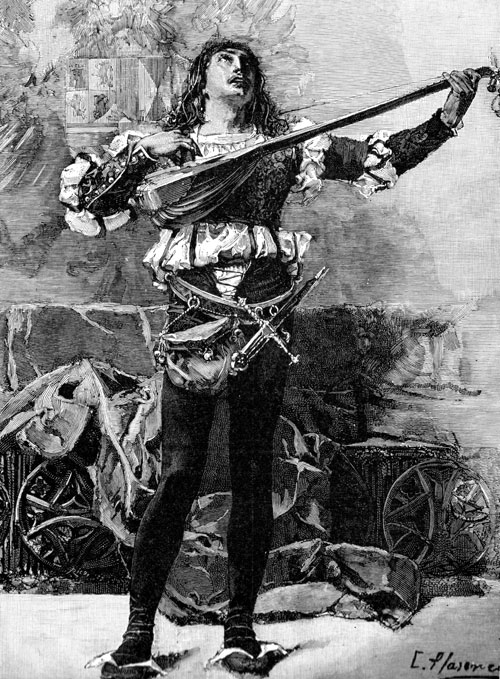
This is a variation of the Bard class as it appears in the C&C Player's Handbook.  It is based not so much on the viking skald, but rather more on the traveling musicians of Irish and Welsh lore, as well as the British troubadour.  The Minstrel is less of a warrior than the Bard, and relies more on subtlety, as well as some magical ability.

There are many similarities between the two classes, as one might expect.  Charisma is, of course, the Prime Attribute for both classes, and the EPP chart is also the same.  The Minstrel is allowed the same armor and weapons as the Bard, and both classes may be of any alignment.  The Bard's special abilities (Decipher Script, Exalt, Legend Lore, Fascinate, and Exhort Greatness) are also shared by the Minstrel.

Being less of a straight-up fighter type, the Minstrel uses d6 for their Hit Dice (instead of d10), and their BtH progresses as per a Rogue.


Minstrels also have the Listen ability, as per the Rogue class (wearing metal or large helms negatively affect using this ability, of course).  They also have the Pick Pockets ability, to represent their ability with various sleight-of-hand tricks, but their bonus using this ability is only equal to half their level, round up (for example, a 7th level Minstrel would only get a +4 bonus to attempt this ability).  Because they are well traveled, and it is useful to be able to perform to a wide variety of audiences, Minstrels also get Bonus Languages: they get +1 language that they read and speak at 1st level, and they gain another language at 6th level, and another again at 11th level.  Also, they can use the ability modifier for CHR instead of INT to help determine the number of starting languages they speak, assuming that their CHR score is the higher of the two (which it probably is).

Last but certainly not least, Minstrels are also spellcasters.   They will never be the equal of equivalently trained Wizards or other spellcasting classes, but combined with their other abilities, they still get by pretty well for themselves.  The use of their spells (also known as 'songs of power') require the minstrel to play a musical instrument and sing while the spell is being cast; the singing and playing are the Verbal and Somatic components of the spell, while the instrument being played acts as the Focus.  The musical instrument/Focus replaces most Material components usually required by the spell, although Material components that are fairly expensive (100 GP or more) are still required.

Otherwise, Minstrels learn, prepare, and cast spells as other arcane spellcasters do.  They gain bonus spells for having a high INT score, in a manner similar to Wizards and Illusionists. They carry their own spellbooks (a.k.a. 'songbooks') for the purpose of preparing their daily spells.  Because the written notes for these spell include both magical and musical notations, any given song of power usually takes up twice as much space in the songbook as an equivalent spell in an arcane caster's spellbook.

Spells per day
Level              0     1     2     3     4     5     6
1                  1
2                  2     
3                  2     1
4                  3     1
5                  3     2     
6                  3     2     1
7                  3     3     1
8                  4     3     2     
9                  4     3     2     1
10                 4     3     3     1
11                 4     4     3     2     
12                 5     4     3     2     1
13                 5     4     3     3     1
14                 5     4     4     3     2    
15                 5     5     4     3     2     1
16                 5     5     4     3     3     1
17                 5     5     4     4     3     2     
18                 6     5     5     4     3     2     1
19                 6     5     5     4     3     3     1
20                 6     5     5     4     4     3     2 

0-LEVEL SPELLS
1. Comprehend Languages
2. Dancing Lights
3. Daze
4. Detect Magic
5. Ghost Sound
6. Influence
7. Message
8. Prestidigitation

1st-LEVEL SPELLS
1. Alarm
2. Animal Friendship
3. Charm Person
4. Hypnotism
5. Identify
6. Read Magic
7. Remove Fear
8. Sleep
9. Sound Blast
10. Ventriloquism

2nd-LEVEL SPELLS
1. Calm Animals
2. Command
3. Hypnotic Pattern
4. Misdirection
5. Scare
6. Shatter
7. Suggestion
8. Tongues

3rd-LEVEL SPELLS
1. Charm Monster
2. Dispel Magic
3. Emotion
4. Fear
5. Hold Person
6. Lesser Restoration
7. Remove Curse
8. Remove Paralysis

4th-LEVEL SPELLS
1. Dismissal
2. Dispel Illusion
3. Hold Monster
4. Legend Lore
5. Sending
6. Shout

5th-LEVEL SPELLS
1. Dream
2. Feeblemind
3. Mass Suggestion
4. Nightmare
5. Permanency
6. True Seeing

6th-LEVEL SPELLS
1. Awe
2. Geas
3. Insanity
4. Repulsion

Monday, April 8, 2013

Monster Monday: Swordwraith

Swordwraith

No. Enc.: 1
Size: Medium
HD: 8 (d12)
Move: 30 ft
AC: 18
Attacks: Incorporeal Weapon (1d12)
Special: Energy Drain, Incorporeal, Darkvision
     60', Daylight Powerlessness, Unnatural Aura
Saves: M
INT: High
Align: Lawful Neutral
Type: Undead (Extraordinary)
TR: Nil
XP: 900+8


A swordwraith is an extremely rare form of undead, the result of a Lawful Neutral warrior of great skill (8th level or higher) who dies due to the betrayal of a comrade-in-arms.  Three days after the warrior's death, his or her spirit may return as a swordwraith, to seek vengeance against those who betrayed their shared cause.  Upon finding and slaying the traitor, most swordwraiths then pass on to whatever afterlife awaits them, but a few continue to stalk the earth, striking down those who draw the swordwraith's ire.

The swordwraith appears as a spectral warrior, bearing the wounds and injuries they did at the moment of death, up to and including lost limbs and decapitations (of course, the loss of a head or limb does not hinder the swordwraith in any fashion).  Despite the name, a sword-wraith might use any weapon, not just a sword, depending on what weapon they specialized in during their living years; a few even use missile weapons (standard range for the missile weapon in question, with the swordwraith never running out of arrows, bolts, sling bullets, etc).  They can travel tirelessly by night, remaining relatively dormant in the shadows during the daylight hours.

Combat: A swordwraith is normally insubstantial, like a more standard wraith, and thus only magical weapons of +1 or better can affect their ectoplasmic form. A swordwraith attacks by passing through objects to attack their foes unawares. They strike, disappear back through an object, and return again, harrying their opponents unto death.

Incorporeal Weapon: The swordwraith's weapon of choice does 1d12 damage (no matter what a normal version of said weapon does).  Due to the swordwraith's great skill with their chosen weapon, that are +3 to hit with it.

Energy Drain: In addition to suffering the above normal damage, living creatures hit by a swordwraith’s attack lose one level. For each such level lost, the swordwraith heals five hit points. These losses are permanent, and can only be regained by the use of a Restoration or a Wish spell.

Unnatural Aura: Animals, whether wild or domesticated, can sense the unnatural presence of a swordwraith at a distance of 30 feet. They will not willingly approach nearer than that, and panic if forced to do so; they remain panicked as long as they are within that range.

Sunlight Powerlessness: Swordwraiths are powerless in natural sunlight and flee from it. A swordwraith exposed to direct sunlight cannot attack, and must retreat.

Inspiration: Warren Zevon's "Roland the Headless Thompson Gunner",  NOT based on the 'undead template' of the same name as created by WOTC (honest!)

Saturday, April 6, 2013

Banner of Three Swords

Highly prized by kings and generals, the Banner of Three Swords is a powerful magical item that grants great aid to armies who fight under its aegis.  Specifically, it grants all who fight while the Banner is being held (within line-of-sight of the Banner) the following bonuses, for the duration of the battle:
  • +2 to all attack rolls
  • +2 temporary HD
  • +4 to all attribute checks, class ability checks, saving throws, and morale checks
However, these bonuses come at a cost.  The bearer of the Banner suffers a -4 penalty to AC, and a -4 penalty to most saving throws.  They do gain the temporary HD listed above, and have a +4 bonus to resist any attempts to take the banner from them, magical or otherwise. Due to its size, the bearer of the Banner can not otherwise attack while holding it.  The bearer of the Banner must understand and freely accept the risk involved; someone bearing the Banner through ignorance, coercion, or trickery confers none of the above-listed bonuses to those who fight under the Banner.

Those who die bearing the Banner are usually accorded much honor and respect.  If a PC dies bearing the Banner, they should receive some sort of bonus to creating their next character.  If using an Honor system (like that used in the 1st ed AD&D Oriental Adventures rulebook), grant the dying character double the "heroic death" honor award.  If not, the player's new PC can either choose to start one level higher than normal, or add +1 to any two attribute scores.

Inspired by Marvel Graphic Novel #15: "The Raven Banner - A Tale of Asgard"

Monday, March 25, 2013

Monster Monday: Serpent Men


Serpent Men


No. Enc.: 1-20
Size: Medium
HD: 2 (d8)
Move: 30 ft, 15 ft swim
AC: 14
Attacks: Weapon or Bite (1d3)
Special: Darkvision 60', Spellcasting
Saves: M
INT: Superior
Align: Neutral Evil
Type: Humanoid
TR: 2
XP: 20+2

Serpent Men are among the eldest of mortal races.  They are humanoid in shape, ranging from 5 to 6 feet tall, with scaly skin and snake-like heads.  They once ruled over mankind and other such races, but were eventually overthrown and almost exterminated as humanity fought back against their oppressors.  These days, their numbers are relatively few, and they usually live among humans, thanks to their gift for illusion, often attempting to slay those who rule over others, and taking their place afterwards.  They worship snake gods such as Yig and Set. Wise men know that, due to the construction of their throats, serpent men can not utter the phrase "ka nama kaa lajerama", and will utter this if they suspect the presence of mankind's ancient foes among their midst.   Serpent men also can not bear the image of a dragon (their ancient enemies) upon their person, and this can also be used to identify one or more of their number. Serpent men are a very long-lived race, with a few of their number over a thousand years old, although most are much younger.

Spellcasting: All serpent men are spellcasters, their magicks deriving from an era when the division between arcane and divine magic was not so sharply defined.  Most serpent men can cast spells as a wizard from 1st to 5th level, although a few of their number are more skilled (higher level serpent men spellcasters will have HD equal to half their wizard level, round down, although this will never exceed 5 HD).  Their magics tend toward illusion and subtlety, and they generally do not know the more potent battle magicks used by mankind (human and elven wizards will usually force any apprentice to utter the above-mentioned shibboleth to ensure that they are not unknowingly teaching new magicks to these degenerate beings. Serpent men will usually cast from the following spell list:

0-LEVEL SPELLS

1. Arcane Mark
2. Change Self (see notes below)
3. Detect Illusion
4. Detect Magic
5. Ghost Sound
6. Influence
7. Know Direction
8. Message

1st-LEVEL SPELLS

1. Animal Friendship**
2. Bless*
3. Calm Animals**
4. Charm Person
5. Command
6. Comprehend Languages
7. Darkness
8. Daze
9. Hypnotism
10. Identify
11. Obscuring Mist
12. Read Magic

2nd-LEVEL SPELLS

1. Animal Messenger**
2. Fog Cloud
3. Hypnotic Pattern
4. Minor Image
5. Speak With Animals**
6. Speak With Dead

3rd-LEVEL SPELLS

1. Dispel Magic 
2. Explosive Runes
3. Glyph of Warding
4. Hallucinatory Terrain
5. Major Image
6. Remove Curse
7. Suggestion 
8. Tongues

4th-LEVEL SPELLS

1. Charm Monster
2. Confusion
3. Dismissal
4. Fear
5. Illusory Wall
6. Mirage Arcana
7. Scrying
8. Sending

5th-LEVEL SPELLS

1. Bind Spirit (see notes below)
2. Guards & Wards
3. Mass Suggestion
4. Persistent Image
5. Permanency
6. Project Image
7. Summon Monster
8. True Seeing

6th-LEVEL SPELLS

1. Banishment
2. Geas
3. Legend Lore
4. Programmed Image

7th-LEVEL SPELLS

1. Greater Scrying
2. Sequester
3. Shadowwalk
4. Summon Greater Monster

8th-LEVEL SPELLS

1. Binding
2. Mass Charm
3. Summon Planar Ally
4. Symbol

9th-LEVEL SPELLS

1. Disjunction
2. Weird

*reversible spell (and in fact serpent men wil often only know the reversed versions of said spells)
**'Animals', in this instance, is limited to snake and snake-like beings 

Serpent Men cast the spell Change Self as a cantrip, not a 1st level spell, with the advantage that they can, in fact, create the illusion of becoming another race.  Serpent Men can use higher spell slots to cast this spell, and are often required to do so (due to the limited duration of the spell) to maintain their guises for extended periods (as a result, serpent men pretending to be humans or other races will often have few, if any, other spells prepared).  They can also cast a spell known as Bind Spirit:

BIND SPIRIT, Level 5
CT 1 minute                     R 50 ft                       D permanent
SV none                           SR n/a                       Comp V,S

Any mortal man slain by a serpent man can have his spirit bound into service by his slayer through the use of this spell.  It must be cast within 10 minutes of the victim's demise.  The spirit can not cause harm to the living (and can be turned as a 3 HD undead), although mortals not used to seeing such a spectral sight may have to make a CHR save to avoid fleeing.  These spirits can be used as spies and informants, and their servitude may be passed from one serpent man to another, if desired.

Source: "The Shadow Kingdom" by Robert E. Howard


Tuesday, March 5, 2013

Overknight at the Inn

Just as Villages are often glossed over, so are the inns that adventurers often stay in during their travels.  Still, there are times when a little detail can be useful, both for the inn itself and for whatever other NPC's are staying the night there as well.


First, the name of the Inn in question.  Roll d4 twice to get started (if you roll a 4 on the first roll, use a d3 for the second roll instead) to see what type of words forms the name of the Inn.

1. Person
2. Object
3. Creature
4. Adjective

If there is an Adjective, it always comes first.  A Person will come first, unless there is also an Adjective.  A Creature will always come last.  If there is no Adjective, then there will be an '&' between the two names.  Add 'Inn' at the end of it, and there you go.

PERSON (roll d20)

1. Archer
2. Angel
3. Bandit
4. Baron
5. Count
6. Dancer
7. Duke
8. Friar
9. Hangman
10. Hunter
11. Hag
12. Imp
13. King
14. Knave
15. Knight
16. Nymph
17. Prince
18. Queen
19. Squire
20. Wench

OBJECT (roll d30)

1. Arrow
2. Banner
3. Barrel
4. Boot
5. Bridge
6. Brook
7. Bugle
8. Bush
9. Cart
10. Cask
11. Crown
12. Cup
13. Dagger
14. Fiddle
15. Flagon
16. Flask
17. Glass
18. Glove
19. Goblet
20. Helm
21. Horn
22. Quiver
23. Rose
24. Shield
25. Spear
26. Staff
27. Sword
28. Vine
29. Whistle
30. Willow

CREATURE (roll d6,d6)

1,1 Boar
1,2 Bear
1,3 Cow
1,4 Cock
1,5 Crow
1,6 Deer

2,1 Dragon
2,2 Duck
2,3 Eagle
2,4 Elk
2,5 Falcon
2,6 Fox

3,1 Fowl
3,2 Frog
3,3 Goat
3,4 Goose
3,5 Griffin
3,6 Hare

4,1 Hart
4,2 Harpy
4,3 Hawk
4,4 Hog
4,5 Horse
4,6 Hound

5,1 Kestrel
5,2 Owl
5,3 Pheasant
5,4 Pig
5,5 Rabbit
5,6 Ram

6,1 Sheep
6,2 Sparrow
6,3 Stag
6,4 Swan
6,5 Toad
6,6 Wolf

ADJECTIVE (roll d30)

1. Bald
2. Big
3. Bonny
4. Burly
5. Burning
6. Buxom
7. Crowing
8. Dancing
9. Dirty
10. Flying
11. Giddy
12. Happy
13. Howling
14. Jolly
15. Leaping
16. Little
17. Lone
18. Long
19. Lucky
20. Merry
21. Noble
22. Roaring
23. Royal
24. Singing
25. Sleeping
26. Ye Olde
27. (number)
28. (color)
29. (metal/jewel)
30. (roll twice on this table)

For Number, roll d8+1, giving a range of adjectives from Two to Nine (anything following should be plural, or course).  For either Color or Metal/Jewel, roll on the subtables below:

COLOR SUBTABLE (roll d8)

1. Black
2. Blue
3. Brown
4. Green
5. Grey
6. Red
7. Scarlet
8. White

METAL/JEWEL SUBTABLE (roll d8)

1. Brass
2. Bronze
3. Copper
4. Golden
5. Iron
6. Ivory
7. Jade
8. Silver

As for the inn itself, if it is situated in a village, it will have 2d4+2 rooms that it rents out, in addition to the common room.  If it has 8+ rooms, there is a 1-in-6 chance the building has two stories, otherwise it is an one-story structure.  If in a town or city, the inn will have 3d6+2 rooms for rent (plus common room); assume any such structure with 11+ rooms is automatically a two-story building  Most rooms can hold two human-sized travelers for the night with minimum fuss.  There is a 2-in-6 chance of there being a stable nearby for the horses (or really poor travelers).  There will be 1-2 primary owners (if two, even odds of it being a married couple), with a number of servers and other help equal to 1d3 + (number of rooms for rent/5, +1 if there is also a stable), most of them probably related to the owner(s). There is a 1-in-20 chance of the Innkeeper(s) being Eeeeeeevil (i.e. spy for foreign power, dangerous cultist, or just killing travelers via secret doors into the rooms so they can steal their gold and make meat pies from their bodies). 


Of course, there's no guarantee that there are going to be enough rooms for all of the PC's to sleep in.  That depends, after all, on what other travelers are staying overnight there.  Roll three times on the Common Travelers table below if in a village, four times if in a town or city; roll an extra time if there is a fair or religious festival going on in the area at the time.

COMMON TRAVELERS (roll d8)

1. 2d3 common craftsmen (i.e. potters, masons, etc) traveling between towns, probably staying in the common room.
2. 2d4 criminals - could be local members of the thieves' guild, bandits, slavers, etc.  Might be staying in the common room, or might be renting rooms (two per room).  Probably won't attack while in the inn, but may ambush the PC's if they don't look strong enough.  Most will be 1st level, but the leader will be 1d4+1 level.
3. 2d4 fighters, possibly either traveling guardsmen, or mercenaries for hire.  Even odds whether they are renting rooms or sleeping in the common room.  1st level, with a leader 1d4+1 level.
4. 1d3 locals, probably sleeping in the common room because they don't want to go home this particular night.  If more than one, they might be getting together for some secret meeting (conspirators, sexual tryst, etc.), in which case they will have rented a room.
5. 1d2 merchants, renting rooms (possibly a room each).  Will have 2d3 1st level fighters as guards with them, who may or may not be sleeping in the common room, and 1d3-1 apprentices, who will definately be sleeping in the common room.
6. 1 lesser member of nobility, who will (of course) have a room to themselves.  They will have 1d3 guards (1d4 level fighters) and 1d2 servants with them, who will also be sleeping two to a room.
7. 2d4 pilgrims, all sleeping in the common room.  There is a 1-in-10 chance that one of the pilgrims is actually an adventurer or former adventurer (roll as per Uncommon Traveler, below).  There is a 1-in-6 chance there is a Cleric with them (1d6 level), probably renting a room for themselves.
8. roll on the Uncommon Travelers table below

UNCOMMON TRAVELERS (roll d12)

(assume that there is only one of each, unless otherwise mentioned, 2d4 level, and will definitely have a room to themselves, 3-in-10 chance is actually a demi-human)

1. Assassin
2. Barbarian
3. Bard
4. Cleric (even odds 1d6 acolytes are with them, either two to a room or sleeping in the common room, 1-in-20 chance is a Druid instead)
5. Fighter
6. Knight (4-in-6 chance has a 1st level squire with them, in their own room)
7. Magician (1-in-10 chance is an Illusionist instead)
8. Paladin
9. Ranger
10. Thief
11. Adventurers (2d3+1 in number, 2d3 level each, reroll d10 on this table to determine class for each)
12. roll on the Special Travelers table below

SPECIAL TRAVELERS (roll d6)

(all except the last option will, of course, be shapeshifted to appear human (or at least humanoid), all will be alone unless noted, and all will have rooms to themselves except where noted)

1. Demon (probably a Succubus)
2. Doppleganger
3. Dragon (either Silver or Gold)
4. Rakshasa
5. Lycanthropes (either 1d3 werewolves or 1d4 wererats, either sharing rooms or sleeping in the common room)
6. Ghost (not actually renting a room, of course... the inn is haunted!)

Monday, March 4, 2013

Monster Monday: Broo

Something I'm going to try every now and then, posting C&C stats for various monsters, either adapted from various games or media, or original creatures.


Broo

No. Enc.: 2-6, 6-36
Size: Variable, usually Medium
HD: 2 (d8) + 2 HP (but see below)
Move: 30 ft (but see below)
AC: 13 (see below)
Attacks: Weapon (usually 1d6) or Head Butt (1d4)
Special: Chaos Features, Disease, Mixed Heritage, Poison Immunity, Track
Saves: P
INT: Average
Align: Chaotic Evil
Type: Humanoid
TR: 2
XP: 25 + 2 per HP (+5 per beneficial chaos ability)

Broo are chaos-spawned humanoid creatures that usually look somewhat similar to humans or other humanoid creatures, but with a goat-like head (or occasionally some other horned creature, such as deer or antelope).  They are vile creatures, given to depraved practices, and even other evil humanoids will usually shun them, in large part because they are also virulent disease spreaders.  They worship gods of chaos and disease.  9 in 10 broo are male, and they kidnap other humanoids and animals to mate with.  They are most common in wastelands, wilderness, swamps, and mountain areas, and will usually make their home in either caves or ruins.

Their skin is naturally tough (AC 13), but they often wear scavenged leather and/or piecemeal armor (AC 14), and about half of them will have shields, as well (AC 15).  Of those not carrying shields, 1 in 6 will have some sort of missile weapon.  They will carry a variety of weapons, with spears being common.  When a smaller group/patrol (2d3 in number) of broo is encountered, if there are 5+ in the group there will also be a sub-leader (3HD+3) present. There is also a chance (roll d8 equal to or less than the number present) that there will be a shaman with them (treat as 2nd level cleric).  In a broo nest, there will be 6d6 'normal' broo, along with 1d3+1 sub-leaders and a 4HD+4 chieftain (who will be +1 to hit and damage in melee combat due to higher STR), as well as 1d4+1 shamans, one of which can cast and fight as a 3rd level cleric.  There will also be 1d10 slaves and/or breeding creatures held captive, as well.

In areas where broo are not uncommon, farmers will shun having goats as livestock.

Combat: Broo are raiders, stealing both wealth and captives, the latter for their degraded rites as well as to impregnate to create new broo.  They enjoy the fact that their attacks will also spread disease among their victims.  They usually do not fight to the end (unless defending their nest), and will usually flee after losing half their number during a given combat.

Chaos Feature: Any given broo will have a 2-in-6 chance of having some unusual chaos feature (sub-leaders, chieftains, and shamans have a 3-in-6 chance).  Roll a d30 on the table below for each individual broo:


1 - Has two heads, gets two saving throws verses any magical effects that are mental in nature (i.e. charm, illusions, etc.), and only half normal chance of surprise
2 - Has only one eye (like a cyclops), -2 to any missile attacks
3 - Four arms, gets to make two melee attacks per round
4 - 1d3+1 tentacles instead of arms, can weild weapons or attack for 1d4 damage, gives extended melee range for attacks
5 - +1d4 to all magical saving throws
6 - +1d3 modifier to STR, probably has a larger (1d8) melee weapon
7 - +1d3 modifier to DEX, will also carry missile weapons
8 - +1d3 modifier to CON, +1 HP per HD
9 - Spits acid, 1d8 damage 1d3 times per day, 15 feet range, DEX save to avoid, armor and gear will be damaged if not quickly removed
10 - Regenerates 1 HP per round until dead
11 - +1d4 to natural AC
12 - +10" to move
13 - Immune to magical scrying/detection
14 - Electrical touch, 1d6 damage 1d3 times per day, can be conducted through metal weapons
15 - Claws, 1d4 damage, can also secrete type III poison 1d3 times per day
16 - Can cast spells as per a 1st level Wizard
17 - Wisdom Drain, as per Lamia abilty, 1d6 times per day
18 - Prehensile tail that can fire 1d3 spikes per round, doing 1d6 damage per spike, as per the Manticore ability, maximum 2d6 spikes per day, 40 ft range
19 - Innate sense of direction, as per the Minotaur Natural Cunning ability
20 - Rust metal items 1d3 times per day, as per a Rust Monster
21 - Immune to all fire-based attacks
22 - Create vile stench that nauseates non-broo, 1d4 times per day, as per the Troglodyte ability
23 - Can adhere to and climb any wall or surface, like a spider
24 - Can detect magic, 30' range, automatically
25 - Create silence, 15' radius around self, 1d3 times per day
26 - Upon death, explodes in 3d6 fireball, 10' range, DEX save for half damage
27 - Can become invisible for 1d4 rounds, 1d3 times per day
28 - Read thoughts, 50' range, last 1d10 minutes, 1d3 times per day
29 - Speaks and understands all languages
30 - Chaos loves you, roll twice on this chart

Disease: Broo are not only completely immune to disease, but are virulent transmitters of disease, as well.  Any successful attack by a broo has a 3-in-6 chance of forcing a CON save vs disease.  Failing this save reduces the victim's movement range by 1/2, inflicts a -2 penalty to attacks, AC, and saving throws, and does 1d6 damage (that will not heal from non-magical means until the disease has run its course).  Each week after the initial infection, another CON save is required; failure means another 1d6 damage, and the penalties to movement and other actions still applies for yet another week, after which the victim must save again.  Once a saving throw is made, damage suffered will start to heal normally, and penalties will end after 1d3 days.

Mixed Heritage: Broo are a race of mongrels, and their individual heritage can vary wildly. Roll 1d100 for each individual broo on the table below:

01-04 antelope (move 40', head butt 1d6)
05-08 bugbear (darkvision 30')
09-12 cattle (+1d3 STR modifier, +1 HD)
13-14 centaur (darkvision 30', move 50', 2 hoof attacks 1d6 damage, +2 to track)
15-18 deer (move 40')
19-22 dog (d6 HD, +4 to track)
23      dryad (charm person once per day)
24-31 dwarf (deepvision 60', +2 save vs arcane magic, +1 save vs fear, move 20')
32-39 elf (+1 to hearing checks, twilight vision, +1 move silently, +5 save vs sleep/charm)
40-44 gnoll (darkvision 30')
45-47 gnome (darkvision 30', +2 to hearing checks, move 20')
48-54 goblin (d6 HD, darkvision 30', move 20')
55-63 halfling (d6 HD, duskvision, move 20', +1 to hide and move silently)
64-68 hobgoblin (darkvision 30')
69-72 horse (move 40', kick atack for 1d4 damage)
73-83 human
84-88 kobold (d6 HD, darkvision 30')
89-90 ogre (+1d3 STR modifier, +1 HD, darkvision 30')
91-96 orc (darkvision 30', detect smell withing 30', +1 to track)
97-00 sheep

Poison Immunity:  Broo are immune to all non-magical poisons.

Track: Broo are excellent trackers, and can do so as per the Ranger ability.

Source: Runequest (original Chaosium version, Mongoose version), Hero Wars 

Saturday, March 2, 2013

Random Village Generation

Most faux-medieval fantasy worlds are littered with various settlements too small, and too numerous, to be worth detailing too much in advance.  Most fantasy maps won't bother showing anything smaller than the various towns and cities of a given country, unless the map scale is fairly small.  Usually this isn't an issue, and most overland travel by adventurers will gloss over passing through such smaller areas, but it can occasionally be useful to give a little detail to such areas.  If the GM/DM doesn't have anything prepared, a few random rolls can flesh out a few needed details, giving the name and size of the village, as well as notes on what businesses and areas of possible interest might be around (specifically, what would be of interest to the PC's, because 99.99% of the time they're not going to give a rat's ass about how many bootmakers or coppersmiths reside in the area).

(note: for these purposes, a village is any settlement of 1,000 or less)


VILLAGE NAME PREFIX (roll d8,d10)

1,1 Aber
1,2 Ach
1,3 Adder
1,4 Ald
1,5 Amber
1,6 Apple
1,7 Arrow
1,8 Ash
1,9 Auch
1,0 Bal

2,1 Barrow
2,2 Bear
2,3 Bell
2,4 Berry
2,5 Birch
2,6 Black
2,7 Bow
2,8 Brown
2,9 Brad
2,0 Buck

3,1 Bull
3,2 Bur
3,3 Caer
3,4 Carn
3,5 Corn
3,6 Crow
3,7 Cul
3,8 Darth
3,9 Deer
3,0 Drum

4,1 Duck
4,2 Dun
4,3 Elm
4,4 Ever
4,5 Fair
4,6 Fox
4,7 Free
4,8 Goat
4,9 Green
4,0 Grey

5,1 Hast
5,2 High
5,3 Hog
5,4 Hook
5,5 Horn
5,6 Key
5,7 Kings
5,8 Lang
5,9 Long
5,0 Maple

6,1 Marble
6,2 Mid
6,3 Mor
6,4 Nor
6,5 Oak
6,6 Ox
6,7 Pad
6,8 Pax
6,9 Pen
6,0 Pine

7,1 Queens
7,2 Ram
7,3 Red
7,4 Rest
7,5 Rose
7,6 Salt
7,7 Small
7,8 Smoke
7,9 Stock
7,0 Sun

8,1 Swan
8,2 Twin
8,3 Way
8,4 Well
8,5 White
8,6 Wolf
8,7 Wood
8,8 York
8,9 (directional prefix)
8,0 (geographic prefix)

Directional prefixes (north/south/east/west) are usually determined by the village's relationship to the center of the nation as it existed when the village was first founded (the borders may have since changed, of course).  Or you could just roll a d4 to randomly pick one.

Geographical prefixes are names such as Cliff, Glen, Hill, Lake, Mount, Sand, and Sea, dependent on the local terrain.

VILLAGE NAME SUFFIX (roll d6,d10)

1,1 axe
1,2 bole
1,3 bury
1,4 combe
1,5 coor
1,6 court
1,7 cott
1,8 dale
1,9 dell
1,0 edge

2,1 firth
2,2 green
2,3 hall
2,4 ham
2,5 heath
2,6 hart
2,7 hold
2,8 holm
2,9 hook
2,0 hurst

3,1 ing
3,2 land
3,3 leaf
3,4 lund
3,5 ly
3,6 mead
3,7 mont
3,8 mouth
3,9 nock
3,0 pool

4,1 rach
4,2 rook
4,3 root
4,4 scar
4,5 shaw
4,6 shield
4,7 shire
4,8 side
4,9 stead
4,0 thorn

5,1 thorpe
5,2 ton
5,3 vale
5,4 view
5,5 ville
5,6 way
5,7 well
5,8 wich
5,9 wick
5,0 worth

6, x (geographic suffix)

Geographical suffixes can include the following - bank, bridge, brook, bush, creek, field, ford, glen, hill, knoll, lake, moor, pass, port, ridge, shore, tree, valley, wood

Not all prefix/suffix combinations will work, and those that obviously don't should be re-rolled.  Some can work with a little tweaking (Restcourt might sound better as Restencourt, for example), and a few might work better as two names instead of one (Bull's Green instead of Bullgreen).

VILLAGE SIZE GENERATOR (2d4)

2-    Tiny
3     Small
4     Medium
5-6  Large
7+   Very Large

-1 to the roll if the area has only been settled in the last century or so, +1 to the roll if the land has been settled for several centuries without any major calamities, such as plagues or apocalyptic wars.

Tiny villages will number a hundred or less in terms of populace (3d6x5 + 1d10 works fine for my purposes), and will have little of interest to them.  Most villages will have about one building per 6 people or so.

Small villages range from 101-300 people.  They will have a temple (or a sacred grove, if druidic/nature worship is more common in the area), and a 3-in-6 chance of having a tavern, as well.  There will be 1-2 low-level men-at-arms types who might be available for hire as mercenaries or henchmen.

Medium villages range from 301-600 people.  They will have both a temple and a tavern, as well as a 2-in-6 chance (each) for the sort of craftsman that a PC might want to hire to help fix their damaged non-magical gear (i.e. blacksmith, leathermaker, bowyer/fletcher, etc.). There will be 1-3 men-at-arms types available for potential hire.

Large villages will number around 601-800 people.  There will be 1-2 temples, and 1-2 taverns.  There is a 3-in-6 chance each of the aforementioned craftsmen, as well as a 1-in-6 chance of there being an inn.  There will be 1-4 men-at-arms types available for potential hire.

Very Large villages will top out at around 801-1000 people.  They will have 1-2 temples, 2 taverns, a 4-in-6 chance each of the aforementioned craftsmen, and a 3-in-6 chance of there being an inn.  There is also a 1-in-6 chance of there being a small brothel on the edge of the village, as well as a 1-in-6 chance of there being a low-level arcane spellcaster in the area who serves as the local hedge wizard/wise woman/village witch/etc. 1-6 men-at-arms types will be available for potential hire.

1-in-20 villages will be Eeeeeeevil, probably in service of some sinister cult.  If not, 1-in-12 villages will still have some sort of secret that they wish to keep from the outside world, such as worshiping some forbidden/outlawed deity, or engaging in some sort of social practices so far from the norm that even jaded adventurers might be shocked by them.

Tuesday, February 26, 2013

Twenty questions

A continuation from here, twenty questions (and answers), the format ripped off from Jeff's Gameblog, with information about the nation of Gheron, specific to the city of Blacksand (where the PC's currently are) and Amaltha (the nation's capital).

1. What is the deal with my cleric's religion?

The worship of Sarus is one of the few things that can be said to unify Gheron with its immediate neighbors.  Sarus is a demi-god who ascended to divinity several hundred years ago after stealing the hidden sources of power from each of the Elder Gods (who were worshiped during the early days of the Kahmish Empire - their faiths are now publicly outlawed) and then defeating them in combat.  Her priests say that she was a mortal reincarnation of the original creation goddess Aru.

There are also the Druids, who are said to channel the last remnants of Aru's essence, as well as call upon various animal and elemental spirits.  The Druidic faith is relatively strong in Gheron, but far less so in the other neighboring nations.

2. Where can we go to buy standard equipment?

In Blacksand, you want to go to Jillith's Tradery, at the Marketplace.  Pretty much anything that isn't armor, weaponry, or transport, you can probably get from her (and if she doesn't have it, you'll need to hunt down a specialist craftsman, most likely).  She also buys used gear - some say she will also buy and fence stolen materials, but then, some people will say anything, won't they?

3. Where can we go to get platemail custom fitted for this monster I just befriended?

The best armorer in the land would be the dwarf Korrin in Amaltha, but he works primarily for King Thomas, so good luck being able to get him to work for you.  In Blacksand, the city's best armorer would be  Robert the Redbeard, but he is said to be rather particular about who he works for.  The city's second-best armorer, the half-orc Larst, is said to be much less choosy about such matters.

4. Who is the mightiest wizard in the land?

Without a doubt, that would be Brisen, confidante and adviser to King Thomas. In Blacksand, Thomas' younger sister Princess Yasmin is said to be the greatest magician of that city.  If you want to actually hire a wizard's services while in Blacksand, the man known as Morgath is probably your best bet.

5. Who is the greatest warrior in the land?

Most will say that King Thomas, no chessboard ruler, is the mightiest warrior of the realm... he did essentially unify what us now Gheron through the armies he led in battle.  Only one of his knights, Sir Logan, was said to be a greater swordsman, but Logan was killed by the King after the knight was revealed to be having an affair with Thomas's second wife, Katherine.


6. Who is the richest person in the land?

Besides the King, you mean?  Marguerite of House Starling controls the largest mercantile operation in all of Amaltha, and indeed in all of Gheron.  However, in Blacksand it is House Frehald, led by Davros Frehald, that controls the largest slice of the city's economic pie.

7. Where can we go to get some magical healing?

Why, the temple(s) of Sarus, of course!  You do attend regular services, yes?  You have been making regular donations, one hopes?  Ahh... well, you can make a suitable donation to the temple's coffers, hopefully?

The Druids will also heal those who participate in their rites, of course.  They might heal outsiders, but gold is less likely to sway them - rather , certain 'favors' (to be determined by the Druids) would be required... either at time of payment, or as a marker to be called at a later time when the Druids deem it necessary.

8. Where can we go to get cures for the following conditions: poison, disease, curse, level drain, lycanthropy, polymorph, alignment change, death, undeath?

All but the smallest of towns will usually have a cleric of Sarus who can cure disease (including lycanthropy, but only within the first 28 days of infection) and remove curses. Larger towns will have clerics who are also capable of neutralizing poison or restoring lost levels due to level drain.  Only in the cities of Amaltha and Blacksand are there clerics who can reverse involuntary alignment change or raise the dead.  In Blacksand, Sister Pegmull is the one you would try to reach for the greatest of healing magics.  In Amaltha, Sister Flybold is the one you want.

Most major Druidic circles will have someone who can negate poison and cure disease (including lycanthropy, as above).  Only the greatest of Druids can negate an involuntary alignment change, or reincarnate your dead body into another form.

The greatest of clerics and druids can also probably reverse you having been polymorphed, but a wizard of equivalent skill could also pull of such a feat, as well.

9. Is there a magic guild my MU belongs to or that I can join in order to get more spells?

No such order exists within Gheron, where arcane spellcasters are somewhat rare.  They have to find any new spells on their own, although sometimes wizards will trade spells with each other if they feel that they can trust the other party (and vice versa).  Some young apprentice wizards will try to stick with a master for as long as possible so they can have access to their master's spell library.

10. Where can I find an alchemist, sage or other expert NPC?

In Blacksand, both Varlass the alchemist and Keorwyn the half-elven sage have residences that straddle between the Marketplace and the upper-class residential area.  Other such experts? You'll need to ask around, probably spending some coin in the process.

11. Where can I hire mercenaries?

Certain seedy taverns, such as the Saucy Sphinx in Blacksand, might be a good place to start. If you've got lots of money, you might be able to purchase some of the gladiator-slaves from the arena area.  And finally, while the city's leaders wouldn't appreciate you poaching in their domain, if you buy some of the guardsmen from the local barracks a few drinks, they might tell you who would be will to go the sell-sword route.

12. Is there any place on the map where swords are illegal, magic is outlawed or any other notable hassles from Johnny Law?

Weaponry being restricted is more a matter of certain specific buildings within a city or town (no bearing arms in the temple or within the royal palace, obviously), or by individual social status (serfs won't be allowed to own a sword, but rather expected to use more common weaponry if needed, such as spears), than overall geographical limitations thereof. As for magic, it isn't outlawed, and the cities are more open about that sort of thing... but arcane magic isn't exactly popular either, so many people will be quick to assume the worst about a traveling wizard staying overnight in their village or town.

13. Which way to the nearest tavern?

Point a finger in a random direction, and start walking, you shouldn't have to go very far.  In Blacksand, the Saucy Sphinx is favored by adventurers and other low-lifes, the sort of dive where you can drink yourself into enough of a stupor that the idea of risking death and dismemberment in hopes of acquiring gold and glory sounds entirely reasonable.  In a better part of town you can find the Silver Sylph, where by comparison to the Saucy Sphinx the risk of getting your throat slit in an evening bar brawl is significantly lower.  If you need a place to sleep overnight, the Green Dragon Inn* just off of Marketplace isn't a bad bet  (only half the chance of getting bedbugs while you sleep, compared to other similarly priced inns... such a deal!).

14. What monsters are terrorizing the countryside sufficiently that if I kill them I will become famous?

Well, there's that Red Dragon that is said to live in the Deadwood.  Then there are the giants of the Ikol hills, who occasionally make raids into the nearby villages.  Oh, and there's also that Night Hag who is said to ride from village to village on a Nightmare steed.  Hey, good luck with any of those, okay?

15. Are there any wars brewing I could go fight?

No actual wars at the moment - the last proper war was with the nation of Theros, about 15 years ago - there's been an uneasy peace ever since.  That said, there is an uptick in monstrous activity stemming from the borderlands to the West, and military garrisons along the borderlands are trying to recruit extra men-at-arms to help keep Gheron's borders safe.

16. How about gladiatorial arenas complete with hard-won glory and fabulous cash prizes?

Slavery is still legal in Gheron (as well as Gheron's nearby neighbors), a carryover from the days of the Kahmish Empire, so both the cities of Amaltha and Blacksand have gladiator arenas where slaves are forced to fight - free men may also volunteer to join these contests, in the hopes of winning gold and glory.  The various towns don't have arenas proper, but they will usually have walled and/or pit areas where such fighting can occur.

17. Are there any secret societies with sinister agendas I could join and/or fight?

If you knew about them, they wouldn't be very secret, now would they?  That said, there are rumblings of discontent against the King and his rule, and there may well be an organized faction (or factions) plotting against him.

18. What is there to eat around here?

Lots of fish and other seafood along the coastline and waterways, of course.  When the non-wealthy eat any other meat, it's usually either pork or chicken.  Eggs and cheese are fairly common, as are potatoes, onions and carrots.  The porridge and gruel common to the lower classes are usually derived from barley, oats and rye, and bread tends to be of the dark (rye) variety.   Stews and potages are fairly common, especially in the colder months.  Wine is rare and has to be imported, but beers, ales, and ciders are all quite common.

19. Any legendary lost treasures I could be looking for?

There's a huge dungeon said to exist at the southeastern foot of the Kron Hills, a few miles east of the town of Oakhill, that is said to contain all sorts of fabulous treasures.  Also, in the forests of the western borderlands are said to be lost cities that were one part of the Kahmish Empire, now abandoned... what treasures and wonders might they still contain?

20. Where is the nearest dragon or other monster with Type H treasure?

Besides the aforementioned Red Dragon that is said to live in the Deadwood, there's also a Green Dragon - supposedly the same one that killed King Thomas's first wife, the half-elf Salanthala, along with their son - that still supposedly resides in the Buckwood near Amaltha.  It's also rumored that there is a Black Dragon residing somewhere in the marshes just south of the Grandwood.  If dragons aren't your thing, there is said to be a Guardian Naga at the lowest levels of the aforementioned dungeon near the Kron Hills.


*all fantasy universes have a Green Dragon inn or tavern - it's actually part of a multiversal chain

Sunday, February 24, 2013

Gheron

(not dead, just lazy)

Here's some background for the setting of my C&C campaign, should I ever get the chance to run it again...

Gheron is a fairly small country - at about 7,855 sq. miles, it is somewhere between Connecticut and New Jersey in terms of overall land mass.  It is a land of mild summers and harsh winters.  The terrain is varied -  there are no mountains, but there are several rolling hills, as well as several lakes and multiple interconnecting rivers.  There are also several scattered forests, as well as the occasional marsh or moor, and there are several stretches of area that can best be described as shrubland.  For all that, about roughly 55% of Gheron is arable farmland, a far higher percentage than any of its immediate neighbors (most 'clear' hexes will have a village in it, somewhere between 100 and 1,000 people, usually averaging around 600 or so - 1 in 12 such hexes will instead have a thorp, with somewhere between 20 and 100 residents).  Gheron has two cities - the capital city of Amaltha, and the port city Blacksand (also occasionally referred to as Highport, an older name for the coastal city) - as well as ten towns of varying size.  Its overall population is somewhere around 778,000.


(click to enlarge, of course - larger red hexes = 12 miles, smaller black hexes = 2 miles)

Along with its neighbors, it was once part of the Northeastern Marches of the Great Empire of Kahm.  The Kahmish empire lasted for a little over six centuries, but eventually disintegrated under a combination of plague and internal dissent.  The plague destroyed most of what could be called civilization, with only a few city-states here and there keeping the proverbial torch lit against the darkness for the better part of a century.  A holdover of the Empire's legacy is that Gheron, like all the other current nations that are descended from what was once the Empire's domain, still speak the Kahman Tongue.*

About 40 years ago, one of the many petty barons in the area, Thomas of Amaltha, began expanding his realm, consolidating the other nearby lands under his expansionistic rule.  He unified what is now called the nation of Gheron, only being stopped by the borderlands to the west, and the also-expanding nations of Theros to the Northeast and Arradonia to the Southeast.  These days, some quietly refer to King Thomas as "the Cursed"; he has had four wives during his rule, but all are now dead, and he has no living heirs.  His younger sister, Princess Yasmin, in next in line for the throne. 

That vast majority of the population of Gheron is human.  About 3% of the overall populace is halfling - more so in the villages, somewhat less so in the towns and cities, although the town of Lillton is notable for actually having a majority population of halflings.  The various other demi-humans (dwarves, elves, gnomes, half-elves and half-orcs) combined consist of about half of one percent of the nation's populace.

The worship of Sarus is the main faith within the land of Gheron (as well as the other nearby nations).  In more rural areas, the Druidic faith is fairly strong (in the early days of consolidating power, Thomas made an alliance with the Druids to help strengthen his power base).  Because of the political power the Druids have, Gheron is not able to fully utilize the forests within its lands, a sore point for some of Gheron's nobility and military personnel.  Relations between the priests of Sarus and the Druids are cordial enough, if somewhat cool and distant. 

Recently, there has been an increase in monstrous activity coming from the borderlands.  As a result, the King has recently raised taxes throughout the land, in hopes of increasing the military presence along the borderlands.  As one might expect, this has not went over well with all of Gheron's citizens.


(same map, minus the smaller hex lines - makes it easier to make out the various rivers)

To the Southeast, Arradonia is about twice as large as Gheron, but due to less overall arable land, has only about half-again the population.  There are huge forests within Arradonia's borders, and unlike Gheron the Druids have little political sway here, so the rulers of Arradonia can utilize those forests more effectively - among other things, Arradonia has the largest and finest navy in the area.  South of Arradonia the land mainly consists of hard plains and deserts, and the various horse nomad tribes that dwell in said lands occasionally raid into Arradonia's nearby villages and towns.

Northeast of Gheron is Theros, a mountainous land that is about three times as large as Gheron, but due to a dearth of arable land, its population is about halfway inbetween that of Gheron and Arradonia.  The mountains of Theros host a wealth of various precious metals, such as silver and gold, as well as no small amount of iron ores.  As a result, the armies of Theros are very, very well armed - even the lowly commoner footsoldier will often wear metal armor as they march into battle.  To the frigid north of Theros' borders, Viking-style barbarians live, occasionally raiding into the nearby settlements, despite the martial prowess of Theros' citizens.

Gheron has pacts with both Arradonia and Theros.  Both of the neighboring countries would love to conquer Gheron and claim the rich farmlands found within, but both nations also know that any invasion on their part would trigger a response of war from Gheron's other neighbor-country.  The last actual war in the area ended 15 years ago, the forces of Gheron and Theros clashing to a relative standstill.  There has been an uneasy peace ever since.

About a hundred or so miles East of Gheron (not shown on the map) is the island nation of Shalza, which is about 2/3 the overall size of Gheron, and has about 1/3 of the latter's population.  Shalza is heavily dependent on trade with its nearby neighbors, which is aided by the wealth of valuable gems that can be mined on the island.  As with Gheron, both Arradonia and Theros would love to conquer and claim the island nation as their own, both for its wealth and its strategic value due to its location.   Like Gheron, Shalza has pacts drawn up with the two larger nations, designed to keep them both at bay.


*yes, I'm shameless

Wednesday, December 5, 2012

Looks like I'm actually running a campaign now

As it turns out, the godson liked the one-shot I ran for him enough so that he wanted to continue gaming with the character he created.


This time, his parents got to play as well.  I would up running a slightly-tweaked version of the old White Dwarf adventure The Beacon at Enon Tor.  This wound up taking two nights, despite being a fairly short and concise adventure, due to the need to create new characters during the first night.

The group consists of Zeke the Thief, a hyperactive human rogue, played by the boy.  From the previous adventure he has the followers; two human fighters (one male, one female) and a male human cleric.  They were joined for this adventure by a gnomish female illusionist and a human female ranger, rounding out the group nicely (Zeke had a female M-U with him during the first adventure, but she died by way of a nasty critical hit).

The adventure played pretty well, overall, and I can recommend it for someone needing a 1st level C&C adventure that doesn't require too much prep (I should probably note that the above C&C conversion of the adventure was written before the Monsters & Treasure book was released, so some of the monster stats don't quite line up).  I changed a few of the monsters (switching out the Bugbear leading the orcs for a 2 HD orc leader and a 1 HD orc cleric), and I made the titular beacon more magical in nature (a Continual Light spell inside a series of highly reflective mirrors, designed so as to focus the light outward at great range), but I avoided the desire to overly-complicate things.  This is the kid's introduction to D&D-style gaming, and elements that may seem trite and old hat to most of us are still new and interesting to him.  I want to have new discoveries for him at any given session, instead of overwhelming him with too much info all at once.

Although not the final fight of the night, the most interesting combat was when the party lured the orcs in the room next door into an ambush; an arrow and a Color Spray spell promptly took down half of the orcs' number; a failed morale check caused the remaining orcs to quickly flee the tower.


The party was properly rewarded, including acquiring some magic items (also something new for the kid - I didn't have any magic items show up in the first session).  I haven't bothered calculating XP yet, but I suspect Zeke is now either 2nd level, or pretty close to it.  I'll introduce him to the joys of leveling up next time around (which probably won't be until after the holidays).  

As we wrapped up for the night, I let them know that from now on I was going to be letting the players decide the direction and nature of the sessions to come.  I gave them three options (a megadungeon in the nearby hills, a Keep On The Borderlands kind of setup on the far edge of the kingdom, and a nearby coastal town that was quietly putting out the call for adventurers to aid them with some as-yet malady affecting the community).   Once I hear back from them on which way they want to go, I can start fleshing out all sort of maladies to inflict upon their characters.  <insert evil DM laughter here>

Now I just need to finish working on that map of the kingdom...

Saturday, November 17, 2012

C&C: the Bravo class

In most fantasy worlds there are those who live (and die) by violence, but who lack the full training of Fighters and other such warriors.  Picking up what they know mainly from the school of hard knocks, they are brawlers who are not entirely adverse to stealth and guile, as they often operate outside the law.  They are street thugs, muscle for the thieves' guild, back-alley throatslitters, barroom brawlers, village goons, highway bandits, and forested revolutionaries.  They are Bravos.

ABILITIES

Move Silently (Dexterity):  As per the Rogue ability.

Sneak Attack:  Gained at 4th level, as per the Rogue ability.  If wearing armor heaver than leather, this penalty suffers a -1 penalty for each point above AC 12 the armor confers.  Likewise, non-leather headgear confers an additional -1 penalty, as does the use of a non-small shield,

Weapon Specialization:  Gained at 4th level, as per the Fighter ability, granting a +1 bonus to hit and damage.  This increases to +2 at 10th level.

The Bravo also has two other special abilities, which varies depending on whether the Bravo is primarily urban- or rural-based.

Bravos who work primarily in cities or larger towns have the following two special abilities:

Conceal (Dexterity):  As per the Rogue ability.  Penalties for wearing heavier armors apply, as per the sneak Attack ability.

Listen (Wisdom):  As per the Rogue ability.

Bravos who live more in villages, or who live outside of civilization altogether (i.e. in the forest) have the following two special abilities:

Conceal (Dexterity):  As per the Ranger ability.

Survival (Wisdom):  As per the Ranger ability.

PRIME ATTRIBUTE: Strength or Dexterity
HIT DICE: d8
ALIGNMENT: Any non-Lawful
WEAPONS: Any
ARMOR: Cuir bouille, hide, leather, mail shirt, padded, ring mail, scale mail, studded leather, shield (small, medium, or pavis), helm (any except armet or great helm)
STARTING GOLD: 30-120 gp (3d4 x 10)
Level       HD          BtH         EPP
  1         d8          0              0
  2         d8         +1          1,501
  3         d8         +2          3,001
  4         d8         +3          6,251
  5         d8         +4         12,501
  6         d8         +5         25,001
  7         d8         +6         50,001
  8         d8         +7        100,001
  9         d8         +8        200,001
 10         d8         +9        400,001
 11       +3 HP        +10       600,001
 12       +3 HP        +11       800,001
 13+ 200,000 EP per level

The first draft of this was posted many, many moons ago on the old Troll Lords Games C&C forums

Sunday, November 11, 2012

House Rules for Castles & Crusades

Now that I'm a couple of sessions into running my new C&C campaign, I just wanted to write down and formalize my house rules that I'll be using...
  • characters who are spellcasters must have a score of 13+ in their class's Prime Attribute; non-spellcasters need a 9+ in their Prime Attribute
  • the Prime Attribute for Rangers is Dexterity, not Strength
  • characters can increase one of their attributes over time as they level up, based on the combined total score of their six main attributes: (added 11/23/13)
               Attribute Total            Increase An Attribute
               50 or less                   At 2nd level, and every two levels afterward
               51-75                        At 3nd level, and every three levels afterward
               76-90                        At 4th level, and every four levels afterward
               91 or greater              At 5th level, and every five levels afterward
  • saving throw penalties for defending against spells are based on the level of the spell, not the level of the spellcaster; the penalty for saving throws triggered by monster abilities are based on half the monster's HD, rounded up (added 11/23/13)
  • characters are knocked unconscious when they are reduced to 0 HP - the 'death threshold' (the point at which a character dies) is (5 + CON modifier) as a negative number, or (10 + CON modifier) for characters with Constitution as one of their Primes (edited 12/9/12)
  • initiative in combat is determined each round by rolling a d6, adding the character's DEX modifier
  • a 'critical hit' in combat is defined as either a natural 20 (unless only a 20 will hit), or a roll that exceeds the target AC by 10 or more - this does the maximum amount of damage for the attack, and allows a second roll, which does in addition normal damage if the second roll hits, or maximum damage again if the second roll is also a critical hit
  • blunt weapon attacks that reduce a monster or NPC's HP to 0 or below may, at the attacker's option, knock the monster out instead of killing it (this is why clerics use blunt weapons - it's hard to convert the heathens if they're dead (unless you're a necromancer, or course))
  • a combatant can forgo taking damage from a successful attack by sacrificing either a shield or a weapon, under the assumption that is was shattered while parrying/deflecting an incoming attack - the only caveat is that it must make a certain amount of sense for the defender's shield or weapon to be able to absorb the damage of the incoming attack... in practice, this generally means that the incoming attack must either be a blunt or cutting weapon (not counting daggers), as piercing attacks usually would not break an opposing weapon or shield - the defending item to be sacrificed can be either a shield, or pretty much any weapon except a dagger (not counting main-gauches, daggers just usually aren't used much as parrying weapons) (a variant of Trollsmyth's 'shields shall be splintered' rule)
  • melee combatants get a 'free attack' if an opponent with a notably shorter weapon (i.e. dagger vs sword, sword vs spear) closes into melee range, if an opponent moves within the combatant's strike range without stopping to defend themselves (i.e. running around or through the minions to get to the main bad guy), or if a melee combatant turns their back to flee without making a defensive tactical withdrawal - the free attack occurs when the opponent moves into the combatant's strike range, separate and independent of the combatant's normal attack on their initiative count (modified 2/24/13)
  • any piercing or edged attack that does damage will also cause continual bleeding until bandaged or healed - the wounded party will lose 1 HP per minute for the next 1d10 minutes per such attack (damage not to exceed the original amount of damage inflicted by the piercing/edged attack) (added 2/24/13)
  • once per game session, a PC may declare that a henchman/hireling/follower suffers the results of any single attack that the PC takes instead of the PC, if it is reasonable that this could occur, based on the current location of the follower in relation to the PC, and the nature of the attack (added 11/17/12)
  • once per session each person at the table (DM included) may roll a d30 instead of whatever die the situation normally warrants. The decision to use the d30 must be made before the roll (swiped from Jeff's Gameblog)

Thursday, November 8, 2012

Alternate spell memorization rules

Like many players growing up with older editions of D&D, I disliked the need for spell memorization from magic-users.  I had not yet read Vance, and the idea of a wizard forgetting a spell upon casting it made no sense to me, nor did it line up with other representations of magic as per Howard, Leiber, Moorcock, etc.  Truthfully, outside of a specifically Vancian setting it still doesn't make that much sense to me, to be honest... however, in recent years I have come to appreciate a bit more the 'resource allocation' aspect of 'old-school' D&D, i.e. the necessity of having the right spell memorized, the right equipment on hand, etc. for a given adventure.  For my upcoming C&C game I'd like to retain a bit of that pre-adventure planning, while still giving wizards a bit more flexibility in terms of overall spellcasting.


The following alternate rules are designed for Castles & Crusades, but could easily be adapted to earlier versions of Dungeons & Dragons with little muss or fuss.  The only possible hurdle might be if your particular flavor of D&D uses a different time scale - in C&C a round is 10 seconds long, and a turn is a minute long.

First, what the wizard (or illusionist, or whatever) is doing after those 8 hours or so of sleep isn't so much spell memorization, but rather spell preparation.  Think of casting a spell as not unlike firing an arrow from a bow.  There are multiple steps involved in the latter: 1) having a bow in hand, 2) grabbing an arrow, 3) nocking the arrow on the bowstring, 4) drawing the arrow (and bowstring) back, 5) aiming the arrow at the target, and 6) letting loose of the arrow, so that it may (hopefully) hit its intended target.  In preparing their spells for the day, spellcasters are essentially going through the magical equivalents of steps 1-5, leaving only the final step undone so that the final triggering of the spell may be cast at the appropriate moment. 

The implication here is that the casting time given for a listed spell is for that last step, when the spellcaster 'pulls the trigger' on the incantation in question.  A further implication is that a spellcaster can cast any unprepared spell they know, but that it required more time to complete.  An unprepared spell whose casting time is listed in rounds requires an equal amount of time in turns/minutes; if a spell has a casting time listed in turns, the unprepared time required is multiplied by 10.  For example, Dragon Mount has a CT of 2 rounds; an illusionist casting it unprepared would actually need 2 turns/minutes to cast it.  Likewise, Explosive Runes has a CT of 1 turn/minute; a wizard would need 10 minutes of cast said spell unprepared.

The exception here is any spell that has a CT listed in minutes, hours, or days (instead of rounds or turns), requires the same amount of time to cast, prepared or not.  This changes the 'resource allocation' dynamic of spell preparation a bit, but not overly much; such spells are comparatively few, and many of them are of a nature that you would not bother to memorize for a dungeon expedition, but would rather save for 'downtime casting' (i.e. Guards And Wards).  If a spellcaster knows such a spell, they can cast them unprepared at no penalty... if they have the time to do so.

The time required for preparing spells after a good night's rest is, unsurprisingly, equal to the full, unprepared casting time described above.  Preparing the spells Detect Magic, Light, Open/Close, Magic Missile, and Sleep (all CT 1) would only require about five minutes.  Preparing the spell Greater Scrying (CT 1 turn) would require about 10 minutes.

While originally intended for arcane spellcasters, the above system can also be applied to divine spellcasters as well, if desired.  The cleric or druid is spending their morning prayers making the mental preparations required to act as a conduit to channel their deity's favor into a specific miracle/spell.  However, if a spell falls under a deity's primary aspect (i.e. Cure Light Wounds for a Goddess of Healing, or Continual Flame for the God of Fire), then the spell can be cast unprepared at the reduced casting time.