Showing posts with label comic books. Show all posts

Saturday, May 4, 2013

Free Comic Book Day 2013

"Comics!  Get yer free comics!"


You can find a nearby participating store here.

Tuesday, May 29, 2012

When a review becomes a rant

A quick link to Tim Marchman's article at the Wall Street Journal, which was nominally supposed to be about the book Leaping Tall Buildings, instead turns into a screed about the failures of the comic book industry.

"The people who produce superhero comics have given up on the mass audience, and it in turn has given up on them."

Sadly, he's not wrong.

Thursday, May 3, 2012

Free Comic Book Day this Saturday

Not only do we get the Avengers film this weekend, but this Saturday is also Free Comic Book Day, as well.


You can find a nearby participating comic book shop here.

Wednesday, April 25, 2012

Before Watchmen

(Prologue: April has pretty much been a wash, posting-wise.  Between the main computer being taken out by a particularly nasty bit of malware, the wife and I both being laid low for a couple of weeks with a virus of a more biological nature, the last-minute rush to get our taxes done, and a couple of other bits of minor drama have pretty much drained away both the time and the desire to blog on a regular basis.  I'm now shooting for May as my 'get my ass back in the game' target goal.  That said, the following link below is, to my mind, too important not to share.)

For those of you who aren't a part of comics, you probably aren't aware that DC will soon be publishing various prequels to Alan Moore's and Dave Gibbon's Watchmen, without the input of the consent of the writer, Alan Moore.  Watchmen is one of the seminal works of the comic book medium, arguably the seminal work in the field of comics.  And now we're getting these various prequels, under the collective title of Before Watchmen, that quite frankly no one was seriously asking for.


They'll sell, of course, and sell well, because there are a certain segment of fans who don't care about any moral implications regarding this fiasco (quite frankly, a certain segment of comic book fandom is narcissistic and amoral enough that they would shiv their own grandmother to get their comics fix).  But people should care, and Heidi MacDonald over at the Beat has written an extremely detailed article about why you should care as well.

Edit: thanks to Greg Hatcher for pointing out this article, which also touches on the same topic.

Wednesday, February 22, 2012

Sad, but kinda funny at the same time

It never fails.  Have someone comment on one of the elephants in the room of modern American comics - the poor portrayal of female characters by the Big Two, and how that adversely affects female readership -  and the 'angry dumb' (as my friend Greg put it) come out of the woodwork, attacking the messenger for pointing out what should be obvious, with a vileness and stupidity one normally reserves for YouTube comment threads.

Don't believe me?  Check out Kelly Thompson's excellent article on the subject, and then - if you dare - wade into the comment section to see a prime example of certain male comic book fans living down to their stereotype.

Friday, February 10, 2012

DC fails miserably to expand new readership

Hey, remember how DC's 'New 52' was supposed to expand their reader base, attracting new readers who were not part of the already existing comic book fandom, especially hoping to draw in new female readers to expand the traditionally male demographic?  Well, it looks like it didn't exactly work out that way.  According to the Nielsen survey, only 5% of their current readership were new to buying comics when the DC reboot began, and only 7 % of the overall readership were female.  Yes, DC did increase their overall readership, but mainly by attracting already existing-readers who had in the past stuck with either Marvel or the various indy companies.  In other words, the overall numbers increased, but the demographics pretty much remained the same.

Is it any surprise that DC failed to attract new female readers?  Especially when the portrayal of several of their female characters has been, to say the least, problematic?  Even putting aside the negative publicity that DC garnered with the reboot's early portrayals of Starfire and Catwoman, there were only a handful of female creators involved with the New 52, and the few female characters that were starring in their own titles were still firmly entrenched in the superhero mold; while there have always been female readers who like superheroes, they've also always been a minority, and if you want to seriously expand your reader base to include a greater percentage of females, you're going to have to step outside the traditional confines of the four-color superhero genre.   You're also going to have to expand access outside the comic book shop - digital is a good first step, but that's not necessarily enough. 


Perhaps even more disturbing is the fact that only 2% of DC's readers are under the age of 18.  If DC (and also Marvel, presumably) isn't being read currently by kids, then who will be reading and supporting the comic book industry in the years and decades to come?  Publishing a 'kiddy' version of your superhero comics isn't the answer, because kids more often than not don't want to read comics aimed at kids.  You need all-ages comics that are accessible to younger readers, but are also well-written enough to draw in older readers as well.  The trouble is, so many writers (and fans) desperately want their four-color adolescent power fantasies to be respected as serious literature, and as a result many of the superhero comic books out today, in their attempts to be more 'adult', aren't accessible as an all-ages story - the need to appeal to aging fanboys who desperately require their superheroes be faux-realistic and overly gritty is doing so at the cost of future generations of readers. 

I wrote last week about how DC could expand both their female and younger reader base.  I still think it's a workable option, but even so that's only one property for DC to exploit.   If DC is really serious about getting both younger readers and getting a larger female fanbase as well, they have to massively expand outside of their current publishing paradigm, making a concentrated effort to both attract younger readers, and to go beyond the superhero genre to draw in female readers who might enjoy comic books as a medium, but need something besides the usual four-color stuff to attract their interests.  Moreso, you can't just try for a few months and then give up when initial sales aren't what you hoped they would be.  If DC is serious about changing and expanding the current demographics of their readership, they're going to have to commit to the long-term.  Because if DC wants to be a viable entity throughout the 21st century, then business-as-usual simply isn't going to cut it.

Thursday, February 2, 2012

Amethyst

Okay, it's nice that DC is finally getting around to putting out a collected version of Amethyst, Princess of Gemworld. A comic book about a young girl who discovers that she is the orphaned princess of a magical land, the series was aimed at a female readership, but as fans of Sailor Moon and My Little Pony can tell you, such franchises can also attract a significant male readership as well, if there are engaging characters and compelling storylines for them to follow.  Amethyst had both, falling squarely into the better-than-it-had-any-right-to-be category, and as a result it had many male readers as well in its day.

The part that bugs me is that this will probably be sold to comic book shops, and perhaps sold digitally, without any extra effort in reaching today's young female readership.  When teen and pre-teen girls want their comic book fix, the vast majority of them don't go anywhere near a comic book shop (and can you blame them?).  They go to the local bookstore, and head to the manga section.  That's where Amethyst belongs, right alongside all the other magical girl characters that are so popular with young female readers (Amethyst was a 'magical girl' a good eight years before anyone ever heard of Sailor Moon).

So here's a plan for DC: collect 4-6 issues at a time, reprint them in the manga 'digest' size format, print the books in color (because when you're dealing with a series that revolves around houses/clans based on different gemstones, color is, y'know, important), actually make the effort to market them to young female readers (yes, DC, that part's actually essential), rake in the cash, and start building up a female readership that, if you play your cards right, might be with you for several years to come.

Of course, does anyone think that DC would really show that sort of marketing savvy and insight?

Anyone?


No, I didn't think so, either.

Wednesday, November 16, 2011

Rethinking the comic book reviews

It's been painfully obvious that my posting of late has dropped off.  In large part this mainly stems from a lack of desire to continue to write up the capsule comic book reviews.  I've been somewhat dissatisfied of late with how they've turned out.  Because I've avoided giving spoilers in my reviews, and because I'm not the wordsmith that other reviewers are, many of the reviews were pretty darned scant in their content (this was especially true with the middle chapters of extended story arcs - just how many times can you say, 'yeah, this is good, looking forward to the ending', anyways?).

Because of this growing dissatisfaction with the reviews, I've delayed actually writing the damned things, to the point where the backlog forces me to be even more skimpy, just to be able to get caught up.  And because I've felt guilty about letting the comic reviews (which are more 'time-sensitive' than anything else I post) slide, I've held off on writing other posts that I was actually more interested in.  Which has made the blog even more of a wasteland of late.

But I don't want to give up entirely on writing about comics.  I care a lot about the medium, and I like to see cool and interesting things done with it.  I also like to give the occasional shout-out to a well done title that perhaps doesn't get as much attention as it deserves.

So I'm thinking of doing the occasional review here and there, when something catches my interest enough that I want to write about it.  The occasional trade paperback or OGN, perhaps a serialized story arc that has been completed, and the occasional first issue or one-shot. Meanwhile, I'm hoping to write a little more on the gaming side, and occasionally get some other stuff written up as well, such as some more Rush reviews.

For those that actually did read the weekly comics reviews, I hope that someone out there saw something in them that caught their attention, that they might not have looked at otherwise.  If they did pick up something because of one of my reviews, and liked it, I'll count that as a win.

Not admitting defeat, just switching gears...

Monday, October 31, 2011

Capsule reviews: Comics from 10/26


Secret Avengers #18 (Marvel, $3.99, Warren Ellis, David Aja) - This reads kind of like an issue of Planetary, and in case you were wondering, yes, that's a good thing.  Steve Rogers, Sharon Carter, and Shang-Chi have to invade an Escher-like dimension with its own physical laws to keep the Shadow Council from using that dimension to threaten the Earth.  Ellis nails Shang-Chi's character nicely (including his distaste for the "games of deceit and death").  Aja's art is wonderful, and handles the martial arts sequences beautifully.   After last issue's hiccup, this issue is pretty much just as good as Ellis's debut in #16.  Highly recommended.


All-Star Western #2 (DC, $3.99, Justin Gray, Jimmy Palmiotti, Moritat, Jordi Bernet) - Gotham's lords of crime (followers of the teachings of the Crime Bible, an aspect of the DC universe I'm not overly familiar with) decide to get rid of Hex and Arkham, which gives Jonah an excuse to do what he does best - namely, kill a whole lot of SOB's who need killing. As a result, with the extended gunfight in all of its gruesome glory (beautifully illustrated by Moritat), there's a little less room for the interaction and banter between Hex and Arkham.  Which is a bit of a shame, but the issue still moves along nicely enough, ending with our unlikely pair of heroes in quite a bind.

There's also a back-up story, with the first part of an El Diablo tale, where our haunted hero must face the walking dead (what else?).  This didn't grab me quite so much; the set-up here seems rather by-the-numbers, but I'm more than willing to see where Gray and Palmiotti are going with this.  Even with the less-than-stellar backup story, overall this is still one of the best things DC is doing right now.


Legion: Secret Origin #1 (of 6) (DC, $2.99, Paul Levitz, Chris Batista, Marc Deering) - While the basics of the founding of the Legion is fairly well established, there's still obviously plenty of unexplored territory that can be touched upon, as the first issue of this mini-series demonstrates nicely.  Little is changed, but rather is instead fleshed out and expanded upon.  It's a nice trick that Levitz pulls off here, balancing that which is already known with new revelations and insights.  Quite frankly, this should have been released before the two ongoing Legion series; if it had, then perhaps those who tried (and found wanting) the first issues of Legion of Super-Heroes and Legion Lost might perhaps have been more inclined to stick around, having a better grounding with what is admittedly an unwieldy and intimidating story concept to jump into.  Recommended for both long-time Legion fans as well as newbies to the 31st century.


Vescell #3 (Image, $2.99, Enrique Carrion, John Upchurch) - Again this issue has two stories in it, the conclusion to last issue's cliffhanger, as well as a stand-alone story with some new characters.  This issue pretty much has the same strengths and flaws that the preceding two issues did; lots of interesting ideas that aren't fleshed out or executed quite as well as perhaps they could be.  There is some attempt at characterization, but more attention seems to be paid toward establishing all sorts of background detail for this particular setting (I'm beginning to wonder if this wasn't originally conceived as a setting for a tabletop RPG game - the fetishization of background minutiae is a common trait of gamemasters-turned-writers).  I'll be giving this a few more issues, but this series really needs to tighten its chops, and concentrate less on fiddly details and more on clearer storytelling techniques.


War of the Independents #1 (Red Anvil, $2.99, Dave Ryan and others) - A huge crossover story, in the style of Marvel and DC's 'event' books, but instead featuring a myriad of various characters from various independent comic books.  There's something of a hook here that involves a robotic Enkidu (of the Gilgamesh epic) who faced off against some unnamed wizard in the past, and said wizard - with the demon Orcus in tow - faces off in the modern day against a disparate group of heroes (the only one of whom I recognize is Cerebus, who it should be noted pretty much steals every scene he's in).  Then there is the obligatory 'gathering of heroes' sequence, which quite frankly drags on too long.  This is all in service of facing a threat from someone named Razorjack (which strikes me as an odd name for a female character, but what the heck).  The first issue here, quite frankly, isn't very good, but with the groundwork established, hopefully the basic set-up will allow for some good stories to be told in future issues.

Saturday, October 22, 2011

Capsule reviews: Comics from 10/5, 10/12, and 10/19

In a desperate attempt to get caught up from the last few weeks, these reviews (such as they are) will probably be a little more capsule-y than normal...


Action Comics #2 (DC, $3.99, Grant Morrison, Rags Morales, Brent Anderson) - It's one thing to capture a man of steel, it's another thing to break him, as Luthor finds out the hard way.  Morrison's script continues to entertain, smartly updating the '38 Superman concept for the modern day.  Anderson's guest work here on the pencils meshes decently enough with what Morales is doing, enough so that the difference isn't terribly jarring.  Recommended.


Stormwatch #2 (DC, $2.99, Paul Cornell, Miguel Sepulveda) - A little better paced that the preceding issue, but still a bit clumsy in spots.  The best thing about this issue is that we can already see the different factions and power plays that are showing up in the group.  Hardly perfect, but interesting enough to make me want to see this through at least to the end of the first storyline.


Moriarty #5 (Image, $2.99, Daniel Corey, Anthony Diecidue) - Part one of 'The Lazarus Tree' finds us with a Moriarty who is a different man than he was during the Dark Chamber story - coming face-to-face with his own mortality has changed him.  In search of answers, the Professor heads to Burma, where he quickly gets entangled in the local political and criminal maneuverings.  It's not the blockbuster start to a story that #1 was, but it works well enough, especially in terms of the first chapter of a sequel.  Recommended.


Vescell #2 (Image, $2.99, Enrique Carrion, John Upchurch) - Once again, this issue has two stories in it, although the second story is of the 'to be continued' variety.  And once again, the ideas and background presented here are interesting, but the presentation thereof could use a little fine-tuning.  Also, the second story suffers from an excess of sexual content that serves less to drive the story and more to act as clumsy titillation.  Which is a shame, because the core concept of this book is certainly a serviceable one; I only hope that Carrion and Upchurch start to hit their stride sooner rather than later.


Our Man Flint #0 (Moonstone, $1.00, Gary Phillips, Kevin Jones) - Based off of the Flint movies of the '60's, which were parodies of the Bond films.  I've never seen the Flint movies, so I don't know what tone this book is meant to emulate, but this doesn't work as a comedy, and likewise it's a pretty bland action story.  Neither the writing nor the art overly appeal to me, for that matter.  I'll be giving this one a pass.


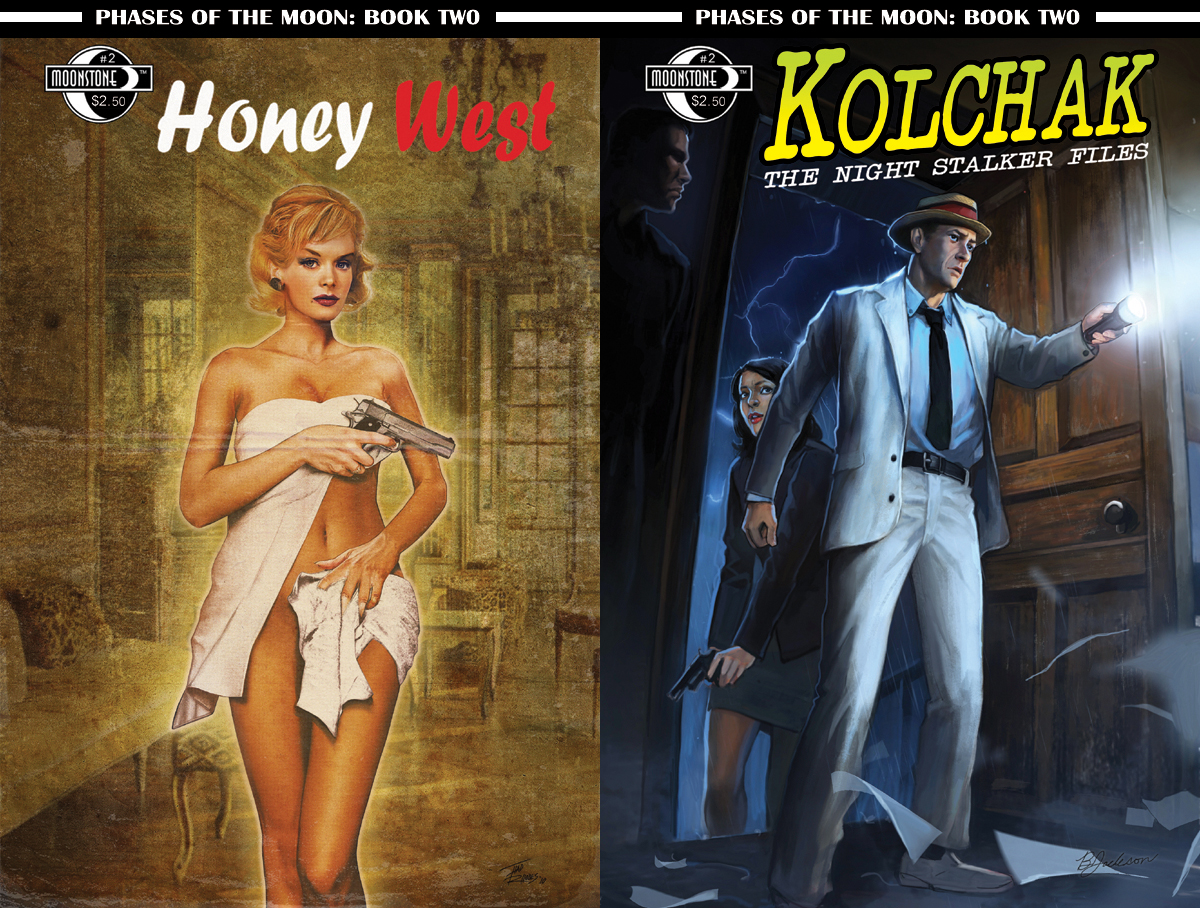
Phases of the Moon #2: Honey West/Kolchak (Moonstone, $2.50, Mark Rahner, Glen Fernandez, Matt Hebb) - After the disappointing first issue of PotM, I wasn't really intending to get the rest of the story, but it wound up in my pull list anyways, and it was cheap, so...

Unfortunately, the second installment really isn't better than the first one was.  The art isn't that great, and it doesn't fit very well with the kind of story being told (the coloring is too bright, as well).  The best part of the issue is the Kolchak story, which isn't fantastic, but holds up a little better, and at least Rahner captures Carl Kolchak's 'voice' and narration fairly well.  I'll probably wind up getting the rest of this, but only because there's only one issue to go, and because, well, it's cheap.


Demon Knights #2 (DC, $2.99, Paul Cornell, Diogenes Neves) - This book continues to be one heck of a romp.  Vandal Savage is hilarious, and pretty much steals every scene he's in.  There's no small amount of humor here (including the fact that nobody seems to be fooled by Shining Knight's disguise), but it's not a comedy, and there's plenty of action, and even some drama here, as well.  Of the 'new 52' titles, Action and All-Star Western are probably better written, but overall this is the title that I'm enjoying the most. 


Legion Lost #2 (DC, $2.99, Fabian Nicieza, Pete Woods) - Wildfire narrates this issue, giving some much-needed backstory that probably should have appeared sooner.  The local townsfolk mourn the loss of their dead, and the time-stranded Legionnaires mourn as well, although they apparently can't be bothered to grieve for their two 'dead' teammates in the process.   The team encounters the first victim altered by the pathogen that was released, and suffice to say things don't go well.  Better than the first issue, but there's still plenty of room for improvement here.

(as an aside, can I point out that the concept of the Legionnaires having so much difficulty with the taint of 21st century Earth's atmosphere, when their transuits have dealt without difficulty with the atmospheres of alien worlds that were far more hostile and polluted, is a really, REALLY stupid and ham-fisted concept?)


The Shade #1 (of 12) (DC, $2.99, James Robinson, Cully Hammer) - An enjoyable first issue that re-introduces the anti-hero of Robinson's Starman series.  It moves a bit slowly, and is more character driven than action oriented, but Robinson handles the pacing of the quiet moments deftly enough.  Which is to say, this is written by good-Robinson and not Cry For Justice-Robinson.  Recommended.


Elric: The Balance Lost #4 (of ???) (Boom!, $3.99, Chris Roberson, Francesco Biagini) - Okay, I officially have no idea just how many issues this story is supposed to run.  Is it too much to ask that this sort of information be included either on the cover or in the publishing info?  In any case, the story moves along decently enough, although it's spread a bit too thin at points.  Eric Beck finally looks like he just might develop a personality, and perhaps even a spine; hopefully, he'll actually continue to grow as a character and perhaps even actually have a meaningful impact on the story.


Glamourpuss #21 (Aardvark-Vanaheim, $3.00, Dave Sim) - C'mon, it's Glamourpuss... if you've read the earlier issues then you know what you're in for.  If not, then this sure as hell isn't the place to jump in to find out if it's for you or not.


Liberty Annual 2011 (Comic Book Legal Defense Fund, $4.99, various writers and artists) - This year's anthology by the CBLDF, as part of their ongoing fight against censorship.  Detailing the multiple stories presented here would taken an entire blog post by itself, so suffice to say that not only is this for a good cause, but the stories presented here are quite good, as well.  Very much recommended.


Legion of Super-Heroes #2 (DC, $2.99, Paul Levitz, Francis Portela) - For those still reading after last issue's non-jumping on chapter, this issue is decent enough, especially for long-time Legion fans.  The threat from Daxam is fleshed out a bit, some needed background info is given, and a few subplots are serviced along the way.  It's a workable 2nd chapter to a multi-part story, albeit not an exceptional one.  


Fables #110 (DC/Vertigo, $2.99, Bill Willingham, Mark Buckingham) - Part three of 'Inherit The Wind' continues to entertain, in terms of both main storyline and the Oz subplot.  Obviously, this isn't the issue to jump in on to see if you like the series, but really, you should already be picking it up.  Yeah, it's that good.


Conan: Road Of Kings #9 (Dark Horse, $3.50, Roy Thomas, Dan Panosian) - I'm still not crazy about the current storyline, but this issue does pick up a notch with some decent action sequences and a nice twist at the end.  Panosian does a decent job of taking over the art from Mike Hawthorne, giving me a bit of hope for the rest of this series.


Dark Horse Presents #5 (Dark Horse, $7.99, various writers and artists) - One of the best values in the market today keeps on moving along nicely; seriously, any comic book fan whose reading doesn't begin and end with superheroes really should be checking this out.   Eric Powell and Andi Watson provide a pair of enjoyable one-off stories, and the various ongoing serials continue to entertain (with the exception of Neal Adams' 'Blood', which just continues to plod along - *sigh*). Both the overall value and the range of storytelling styles and genres make this pretty much a must-read.


Robert E. Howard's Savage Sword #3 (Dark Horse, $7.99, various writers and artists) -While not as overall as strong in terms of content and execution as Dark Horse Presents, this is still worth picking up for any Howard fan, or any fan of action-adventure in general.  The Conan serial ends well enough, finishing up a bit better than I had anticipated.  A western story featuring the Sonara Kid starts off well enough, there's a fair Brule story, and a pretty decent Steve Harrison story here, as well.  The highlight of the issue is a re-printing of the first part of  'The Vale of Shadow', a Kull story illustrated by Tony de Zungia that was first published as a stand-alone graphic novel by Marvel back in the late '80s. 


Near Death #2 (Image, $2.99, Jay Faerber, Simone Guglielmini) - Another fine done-in-one hardboiled story, with Markham agreeing to protect a man whom others are seeking to kill, only to find out that things aren't exactly black-and-white in terms of doing the right thing.  Faerber avoids taking the easy way out here with the story's conclusion, which I appreciate.  Recommended.


Animal Man #1-2 (DC, $2.99 each, Jeff Lemire, Travel Foreman) - One of two DC titles that I initially wasn't planning on picking up, but decided to give a try based on good word of mouth.  I have a fondness for Morrison's run on the original run of this book, and Lemire wisely acknowledges that part of the character's life without directly trying to emulate it.  It's not quite a horror story, but there are certainly horrific elements to it.   It's very well written, although I'm not certain if it's a concept I want to follow in the long-term; that said, I'm more than willing to give the rest of this story a chance, and see just how it plays out.


Frankenstein, Agent of S.H.A.D.E. #1-2 (DC, $2.99 each, Jeff Lemire, Alberto Ponticelli) - Another title that I was originally going to pass on, but had recommended to me anyways.  It's also written by Lemire, as it turns out, and it's another book that I wound up enjoying (perhaps I should give Sweet Tooth a try, if this is any indication).  The basic concept comes off as if someone crossed together the B.P.R.D. with Grant Morrison's run on Doom Patrol, which as it turns out is a pretty neat thing in my book.  Lemire isn't afraid to throw plenty of weirdness and high concepts at the reader; not everyone will appreciate this, especially a certain branch of comic book reader who like their fictions to be easily explained and digested.  That said, I enjoyed it quite a bit, and am looking forward to see where this all goes.  Recommended.

Saturday, October 8, 2011

Capsule reviews: Comics from 9/21 and 9/28

In which I attempt to get caught up from the last few weeks...


Legion of Super-Heroes #1 (DC, $2.99, Paul Levitz, Francis Portela) - Having lost several team members recently due to the events in Legion Lost #1, some of the recent trainees from the Adventure Comics series are brought up to the big leagues.  Of course, the people who trained for years in the Legion Academy are passed over, in favor of a few newbies who had all of one adventure, in which one of their number was killed.  Nope, nothing at all arbitrary about who the Legion chooses for their ranks.

Snark aside, this is a decent enough introduction to a new story arc.  The main story concerns a Legion team investigating a watchworld on the edge of Dominator space that has stopped communications with the United Planets, which moves along well enough.  There's also some subplots advanced and some nice character bits as well, including a nice bit of interaction between Brainiac 5 and Mon-El.  Overall, this issue is enjoyable enough for any Legion fan.

What it isn't is a particularly good introductory issue for a new reader.  While I'm just as glad that DC didn't yet again reboot the Legion continuity, this is still theoretically a potential fresh start that should ideally be new-reader friendly.  Not only is this a #1 issue, it's part of a huge re-launch of the DC line, and as a result may draw in the curious reader who might not otherwise do so under other circumstances.  Other than making sure there are caption boxes giving the names and powers for most of the characters, Levitz makes no special effort to make this issue especially engaging for the new reader, nor does he go out of his way to highlight what makes the Legion so engaging for its long-time fans, and how it's unique as compared to the rest of the DC universe.  Given the floundering status of the Legion in recent years, this was a golden opportunity to bring new readers into the fold.

Sadly, that opportunity appears to have been wasted.  Granted, it doesn't fail to the degree that Legion Lost did in this regard; the story is functional enough, and I no major complaints about Portela's art.  Still, it irks me that what could have been a bright beginning to a new chapter in Legion history turns out to be just another first chapter of yet another story arc.  


Fables #109 (DC/Vertigo, $2.99, Bill Willingham, Mark Buckingham) - Part two of "Inherit The Wind" moves along briskly; about half the issue concerns the choosing of the successor of the North Wind, but there's also further developments with Bufkin and company's continuing adventures in Oz, the ongoing training of the former Nurse Spratt, and even the status of the Farm is briefly addressed.  There's a lot going on here, with several twists and turns along the way, but Willingham and Buckingham handle it all adroitly.  As always, recommended.


Dark Horse Presents #4 (Dark Horse, $7.99, Evan Dorkin, Jill Thompson, Sanford Greene, Chuck Brown, Filipe Melo, Juan Cavia, Robert Love, David Walker, Peter Hogan, Steve Parkhouse, Steve Niles, Christopher Mitten, Howard Chaykin, Ricardo Delgado, Carla Speed McNeil, Dara Naraghi, Patrick Alexander) - Best issue of this anthology series so far.  Greene and Brown's Rotten Apple, Love and Walker's Number 13, Chaykin's Marked Man, and McNeil's Finder all continue to entertain.  There are several new pieces here as well; Dorkin and Thompson provide a delightful Beasts Of Burden story to kick off the issue, Melo and Cavia introduce us to the opening chapter of  The Adventures of Dog Mendonca and Pizzaboy, Hogan and Parkhouse also kick off the Resident Alien storyline, Niles and Mitten kick off the Criminal Macarbe story, Delgado provides us with a beautiful, wordless Age Of Reptiles story, and Naraghi wraps things up with a haunting story called The Protest, with a one-page gag piece Teenagers by Alexander acting as the issue's coda.  All of the stories are quite enjoyable (there's nothing as weak as Neal Adams' Blood to drag things down), and the wide variety of genres and styles is a definable bonus.   This continues to provide one of the best bangs-for-the-buck in the comic book marketplace today.  Recommended. 


Conan: Road Of Kings #8 (Dark Horse, $3.50, Roy Thomas, Mike Hawthorne) - Conan heads down into the catacombs beneath Tarantia, with the child Albiona in tow, in search of the comic's plot.  Along the way, he fights some monsters, meets once again with the various surviving conspirators from last issue, after which more monsters show up.  I suppose I shouldn't be so dismissive, but part of me can't help but think - and I know this is going to sound awful - that this story wold pick up if the kid got whacked sooner rather than later.  As is, the plot for this issue is somewhat thin, albeit ably illustrated by Hawthorne.


Hellboy vol 11: The Bride Of Hell And Others (Dark Horse, $19.99, Mike Mignola, Richard Corben, Kevin Nowlan, Scott Hampton) - Ah, just when I was getting a little depressed about the state of comics today, along comes Hellboy to remind me just how good comics can be.

The six stories reprinted here are all from Hellboy's earlier days, long before he left the B.P.R.D.; chronologically they range from the 1950's to the 1980's.  This is one of the many strengths of the Hellboy universe - when Mignola set up the basic concept of the character many years ago, he allowed himself over three decades of time in which it was stated that Hellboy was having various adventures.  This gave him the freedom to go back and tell whatever stories he wanted to set during those years, without having to tie said stories in to the ongoing more recent story arcs.  As a result, continuity is used as a tool, rather than being a straightjacket to hinder storytelling, or a master that must be served before other concerns.

The stories here are generally smaller in scope then the apocalyptic epics that have shown up in recent years in both Hellboy and B.P.R.D., but are no less effective and enjoyable for that.  One of the great things with these stories is that Mignola is free to choose different artists for different stories, playing to their respective strengths.  As a result, we have Richard Corben illustrating a tale involving lucha libre Mexican wrestlers teaming up with Hellboy, while Scott Hampton provides the art for a gothic tale involving vampires and ghostly yet beautiful females, and Kevin Nowlan helps to show us a demented tale of aliens and farm animals; if you know anything of these artists, you can probably already start to imagine just how well each of those pairings work.

Not only is this a very enjoyable collection in and of itself, but because these stories aren't tied in to more recent events in the Hellboy universe, it's also a fine jumping-in point for anyone curious about the character and the overall mythos surrounding him.  Recommended for both long-time fans and potential newcomers.


Near Death #1 (Image, $2.99, Jay Faerber, Simone Guglielmini) - Hired assassin Markham has a near-death experience, in which the threat of Hell makes him reconsider his ways, after which he seeks to balance the scales by saving lives to make up for all the ones he killed.  It's a simple premise, but an effective one, allowing for all sorts of potential stories as he seeks to thwart his former employers.  One of the interesting things about Markham is that his new goals haven't really changed who he is; he's still an amoral murderous SOB, and it's out of fear, not any moral epiphany, that Markham seeks to make redress.  This raises an interesting question - is it the deed that counts, or the intent behind it? 

This is a strong first issue; Faerber's plot moves along at a nice place, not stretching things out unnecessarily, and hits all the right hard-boiled elements, which Guglielmini illustrates effectively.   Recommended for any fan of crime/noir fiction.


The Spider #2 (Moonstone, $3.99, Martin Powell, Hannibal King, Gary Phillips, Roberto Castro) - This came out a few weeks earlier, but my shop got shorted on copies by Diamond, so I only recently was able to get an issue of this.  The lead story, part one of 'Blood Reign of the Thunder King', involves New York City being deluged with thunderstorms of unusual and unnatural intensity.  Of course, there's someone behind all this, but how does even the Spider fight the weather?  Powell's plot is appropriately over the top here, and King's artwork is suitable to the story, if a little stiff in places.  Meanwhile, part two of the Operator 5 back-up, 'The Faithful', concludes our hero's struggle with the Nordic Cross (for now, at least) in a satisfying fashion, with a suitable mix of intrigue and adventure.  I'm not terribly familiar with Operator 5 as a character, but I would like to see Phillips and Castro do more with the character.  In both stories the semi-monochromatic technique applied to the coloring helps in evoking a period feel, but that visual approach probably won't appeal to everyone, especially the "I hate black-and-white comics" crowd.  Recommended for pulp fans. 


Secret Avengers #17 (Marvel, $3.99, Warren Ellis, Kev Walker) - A mysterious semi-truck is wandering the desolate areas of serbia, kidnapping residents using hi-tech means.  Not necessarily the most engaging of concepts, but Ellis manages to get some mileage (heh) out of it.  There are some cool moments here and there, but overall this isn't as good an issue has the previous one; partially because the story - despite some occasional bits of superhero weirdness - almost comes across as mundane, in spite of its high-tech premise - but also because of Walker's somewhat murky art, which occasionally serves the story well, but also occasionally hinders the enjoyment thereof.

You know what would have improved this issue?  If the evil semi was revealed to actually be U.S. 1 - now that would have been awesome.


All-Star Western #1 (DC, $3.99, Justin Gray, Jimmy Palmiotti, Moritat) - After enjoying the various done-in-one issues that had graced Jonah Hex, I was a little saddened to find out that with the transition to All-Star Western more emphasis would be placed on multi-part stories.  Jonah Hex was one of the few titles out there that delivered quality comics that didn't stretch themselves out, prostate to the unholy god of decompression.

I shouldn't have worried.  I had forgotten that Gray and Palmiotti had occasionally done multi-part stories in the past on Hex, and had pulled it off quite nicely.  It should then come as no surprise that the first issue of All-Star Western is a doozy, gracing us with a strong first chapter that gives us plenty of content, but also leaves us wanting more, laying down the groundwork for the rest of the storyline in a manner that feels neither rushed nor forced.

Hex is called East to Gotham City, where it appears that a Jack The Ripper-style killer is having his way with the local working women.  Hex is forced to team up with Dr. Amadeus Arkham, who in later years will help build a certain Asylum that will be named for him.  Of course, Hex would rather work alone, caring little for Arkham's presence, and the Doctor's first impression of Hex isn't terribly favorable, either (Arkham's continuing attempt to psycho-analyze Hex provides no small amount of entertainment for the issue).  By the issue's end, the unlikely duo realize that the evil they face is far more powerful, and pervasive, that they first anticipated.

This is both a wonderful first part to the current story, as well as an excellent introduction to the character for those who might have overlooked Jonah's adventures in the past. Gray and Palmiotti are at the top of their game, and Moritat, who had recently been working on The Spirit, is pretty much the perfect artist for a book like this.  His style has a certain roughness to it, but is also very fluid, with excellent composition and panel layout.  He also handles various period details well, such as Arkham's use of absinth in a couple of scenes.  It really is just an excellent comic book.  Highly recommended.

Tuesday, October 4, 2011

Jim Shooter dissects Red Hood And The Outlaws #1

While I certainly don't agree with everything former Marvel E-I-C Jim Shooter has said and done, his breakdown of the now-infamous Red Hood and the Outlaws #1 really does highlight what is so very wrong with this particular comic, even aside from the questionable portrayal of the character of Starfire.  You can see the big guy laying down the smackdown here.

Monday, September 19, 2011

Capsule reviews: Comics from 9/14


Mystery Men #5 (of 5) (Marvel, $2.99, David Liss, Patrick Zircher) - Our heroes have a second, and final chance, to thwart Nox and the General's plans.  Despite not being terribly inclined to work together, necessity forces them to do so, and this time they fare better than their previous encounter with out villains, in a taut battle aboard a zeppelin (and really, how cool is that?).  However, victory doesn't come without a price, and one of our heroes makes the ultimate sacrifice.  The conclusion is a satisfying one, although left open enough for future stories to follow.  I hope that there are more stories to come with these characters, as I enjoyed this story quite a bit.  Moreso, Liss and Zircher work well together here, and I hope that they would be able to return for any future issues featuring these characters.  Recommended, especially for anyone who considers themselves a fan of the pulps.


Supreme Power #4 (of 4) (Marvel/Max, $3.99, Kyle Higgins, Manuel Garcia) - There are two conclusions here, one dealing with the French superhuman killing people in Hyperion's name, the other is the final battle between Hyperion and Dr. Spectrum.  The former is dealt with swiftly, partly as a something of a fake-out (given that he was built up as a major threat), but also to give a little more room for the latter to play out, with a few swerves along the way.  This isn't the best written story in the Supreme Power/Squadron Supreme series (among its flaws is that the ending is a little vague in spots), but it gives enough of a sense of resolution for the franchise that it has an ending that works, while at the same time leaving the door open for future stories should this sell well enough to warrant it.


Astonishing X-Men: Xenogenesis (Marvel, $19.99, Warren Ellis, Kaare Andrews) -The last (as far as I know) of Ellis' run on Astonishing X-Men is collected here, and it's pretty much just as good as the two previous volumes of his work on the title.  Once again, he has to dance around the asinine '198' edict, and once again he manages to get a good story out of it, this time mining an old idea from Alan Moore's run on Captain Britain decades ago.  A series of seemingly mutant births are occurring in a small town in East Africa, and it falls to the X-Men to investigate.  Of course, nothing is ever quite that simple, and the ending is, to say the least, bittersweet. 

The script by Ellis is the main selling point here.  The plot is sharp, and the dialogue comes across as fairly natural as well as often quite hilarious.  The art by Andrews is stylistic, slightly cartoony, but overall rather appealing.  If nothing else he knows how to draw people in what appears to be actual clothing (as opposed to skintight spandex), something of a lost art these days.  He also does pretty well with the various action sequences.  Besides the five issues reprinted here, there is also both the uncolored pencils and the original test script for the first issue included here.  If you liked the first two collections of Ellis' Astonishing, you'll like this as well.  Very much recommended.


Demon Knights #1 (DC, $2.99, Paul Cornell, Diogenes Neves) - Whatever faults Cornell had with the introductory issue of Stormwatch, thankfully they're not on display here.  This is essentially a Dungeons & Dragons story set in the DC Universe's past; full of magic and odd characters, and gleefully anachronistic in spots.  Heck, most of our characters even meet in a bar, and if that's not a D&D trope, I don't know what is.  Set four centuries after the fall of Camelot, Madame Xanadu and Jason Blood (aka the Demon) get the most stage time during the first issue, but several other characters also appear, with hints of more details regarding them to follow in the issues to come.  Cornell's story is fun and engaging, and the art by Neves manages to ground the fantastic elements just enough to carry the story, while at the same time embracing the more outlandish and absurd elements therein.  A really fun first issue, which promises a heck of a ride to come.


Legion Lost #1 (DC, $2.99, Fabian Nicieza, Pete Woods) - As a long-time Legion fan, I pretty much had to pick this up.  I don't regret doing so, but if I was new to the Legion I'm not so sure that would be the case.  Seven Legionnaires travel back to the 21st century, in the hopes of stopping the bad guy Alastor from destroying humanity with a deadly virus.  In the process their time bubble is broken, much of their equipment no longer works, and, oh yeah, two of their team members 'dies'.  Not that I believe for a minute that the pair in question is actually dead -  no bodies, no deaths - but quite frankly they were the two characters that I looked forward the most to interacting with the others, and until their eventual return occurs the book will, I suspect, be poorer for not having their characters added to the mix.

As is, other than being a Legion fan, there's not a whole lot here to interest me so far.  While we get a basic idea of the cast and their capabilities, we aren't exactly given much reason to care overly much for them.  Alastor is even less well defined (there were some online postings on CBR some time back that give some insight into his motivation, but if you missed it you're SOL), and so far there just isn't that much there to care about him one way or the other, other than he's the bad guy of the piece.  Even for long-time Legion fans, this feels like you've been dropped in the middle of an ongoing story; on those terms, it's not too bad, but I honestly can't recommend this to anyone not already familiar with the Legion mythos as a gateway into the greater Legion universe.  Quite frankly, I expected better from Nicieza.  The best that can be said is that the art by Woods is decent enough (although it's not his best work by any means).  For hardcore Legion fans only, if the first issue is any indication.

Tuesday, September 13, 2011

Capsule reviews: Comics from 8/31 and 9/7


Secret Avengers #16 (Marvel, $3.99, Warren Ellis, Jamie McKelvie) - Just when I thought I was pretty much done with mainstream Marvel comics, they suck me back in by putting Warren Ellis on one of their titles.  How can I resist?  This is what I want from my four-color superhero comics: tightly written adventure stories dealing with absurdly crazy ideas played absolutely straight.  There's a bit of Ellis's Global Frequency here, as well as a hint of NextWave, but it's also very much its own thing, and very much a superhero comic, even if it doesn't resemble much that is produced by the Big Two these days.

The plot is simple, taking an old idea from Marvel ideas gone by and ramping things up to... oh, 17 or so.  Steve Rogers leads Beast, Black Widow, and Moon Knight to investigate an underground city once built by the Secret Empire, due to the detection of Von Doom (time travel) Radiation being detected.  From there, they make their way through the city, discovering just what's at stake, leading to a taut, satisfying conclusion.

The script by Ellis is tight, giving us just enough to make us care about the characters, and enough pseudo-science to make the threat credible, without drowning the reader in unnecessary minutiae.  Some might complain about the casual violence and killing the Avengers commit here, but you can't run a black ops mission without breaking a few henchmen: this is an operation run by Steven Rogers the super-soldier, not Captain America the superhero.  The art by McKelvie may not be spectacular, but it is solid, and gives a nice sense of scale as our heroes investigate the underground setting.  If Marvel continues to let Ellis tell accessible done-in-one stories like this, then I'm on board for the ride. 


Vescell #1 (Image, $2.99, Enrique Carrion, John Upchurch) -There's a huge amount of information to be processed while reading the first issue of this series.  Some current comic book readers seem to think that not having every little thing spelled out in an obvious manner is somehow a sign of bad storytelling, put personally I like it when a comic has enough packed into it that it benefits from a second or even third reading.  Demons, magic, cyborgs, dimensional barriers being broken, and technology-induced personality transfers between bodies... Carrion isn't afraid to throw a lot of different elements into the mix to tell the story he wants to tell.

Not that everything here is perfect.  Some of the information, as well as the different plot elements of the story at hand, could perhaps have been handled in a smoother fashion.  The issue is slightly bigger than average (36 pages instead of 32), and even then it feels cramped in places.  This isn't aided by Upchurch's art, which is nice in spots, but doesn't carry the story as well as it might.  Also, the backgrounds and shading tend toward the monochromatic; a bit more variety here would have helped.  Still, even though flawed in spots, there's enough her that's of interest to make me want to read the next issue, just to see where all of this is going.


Rocketeer Adventures #4 (of 4) (IDW, $3.99,Dave Gibbons, Scott Hampton, Joe Pruett, Tony Harris, John Arcudi, Brendan McCarthy, Ashley Wood) - Final issue of this anthology mini-series, and overall the quality of the stories has remained consistently high.  "A Day at the Beach" by Gibbons and Hampton is a fun little romp, complete with our title hero riding a surfboard while flying in the air... how can that not be fun?  "Waterlogged" by Pruett and Harris pits our hero against a Japanese submarine, and "The Flight of the Aeronaut" by Arcudi and McCarthy has Cliff clashing against his Nazi opposite number, both stories dealing effectively with the wartime era as a backdrop.  The issue concludes with two nice watercolor illustrations by Ashley Wood.  I wasn't certain initially how much I would enjoy these non-Stevens take on the Rocketeer, but overall this mini-series has been a lot of fun, and I wouldn't object to seeing further tales of Cliff and company from IDW in the future.


Phases of the Moon: The Spider/Domino Lady #1 (Moonstone, $2.50, Steven L Frank, Bill McKay, Remy Mokhtar) - This is the first of three books that form a crosover between six different Moonstone characters, each issue being a flip-book concentrating on a different character.  The issue starts with the Spider investigating a murderous cult, and winds up being framed for the murders, which draws in the attention of the Domino Lady.

I wanted to like this, I really did.  Unfortunately, the art on the two different parts of the book simply did not work for me, being a bit too cartoony for this kind of tale.  The story is okay, but didn't really grab my interest enough to make me want to pick up the other issues in this storyline.  I'm giving the rest of 'Phases of the Moon' a pass.


Action Comics #1 (DC, $3.99, Grant Morrison, Rags Morales) - And so the reboot begins.  Okay, it actually began the week before, but I'm giving Justice League a pass.  The much-discussed remolding of the Man of Steel, bringing him back to the earliest presentation of the character, viewed through a modern lens, is obviously meant to shake up reader's expectations, and hopefully draw in those who have in the past dismissed Superman as a 'boy scout'.

More often than not, the 'back-to-basics' approach eventually fails, but in this instance I think Morrison has pulled it off.  In no small part this is due to the fact that the original concept of a activist crusader against social ills and moribund justice during a time of economic uncertainty is something that can resonate with a lot of people today, in a way that it might not have in previous decades.  There's very much a sense of humanity to the character, that hasn't always been present in more common depictions of him as the 'perfect' superhero.   He's young, he's brash, he's not yet truly invulnerable, he sees things in simplistic terms, he makes mistakes, and there's room for him to grow from all that.  Then there's Luthor, who is very much again in the mold of the Byrne-written evil businessman, but that also works well here, combining two common foes from the early Superman stories, the amoral and unethical businessman with the brilliant scientist mastermind.

Morrison's script is a fun one, packed with little bits of meta-commentary and call-outs to previous era, but the basic story is straightforward enough for a newcomer to enjoy (provided they're not the sort of fan who wants every little thing spoonfed to them in simplistic datapoints), while having enough detail and depth to reward multiple re-readings.  The art by Morales works nicely in conveying the story (especially during the action sequences), and helps to emphasize that this a Superman who is having fun with his abilities, even as he is being sorely tested.  Overall, I enjoyed this very much, and look forward to seeing what follows.   


Stormwatch #1 (DC, $2.99, Paul Cornell, Miguel Sepulveda) - I suspected that the first issue here would be a bit clumsy and awkward in spots, and unfortunately I was right.  Cornell has the unenviable task of introducing multiple characters (many of whom may not be familiar to the reader), giving the basic setup of our book's premise (and how it differs from the original Stormwatch), and of course introducing the plot of the initial story arc.  He makes an game attempt at juggling all these factors, but parts of this first issue are still a bit uneven and forced.  It doesn't help that Sepulveda's art is a little clunky in spots.  Hopefully, now that introductions are out of the way, and the writer-artist team have perhaps a little more breathing space to work with on future issues (this first issue feels as if it was very much produced under a rather tight time schedule), what follows will hopefully be less of a bumpy ride.

Because the basic concept is a decent one; a group of superhumans who work behind the scenes to combat various threats, as opposed to the more public actions of more conventional superheroes.  You also have an appropriately over-the-top threat for our heroes to face (the Moon is attacking the Earth).  It may well still wind up paling when compared to Warren Ellis's classic run on the title (which was one of the best superhero team books ever, and quite frankly was far better than the Authority which followed it), but taken on it's own it should hopefully be an enjoyable enough title to read.  I'll be sticking with this through the initial storyline, hoping that the problems that show themselves here will be smoothed out over time.


Elric: The Balance Lost #3 (of 4) (Boom!, $3.99, Chris Roberson, Francesco Biagini) - Wait, this is a four issue mini, right?  Because while the various disparate plot threads are moving along at a decent pace, if there's only one more issue to wrap things up then quite frankly I can't see how it's not going to come off as rushed.  Also, Eric Beck, our new aspect of the Eternal Champion (and really, 'The Eternal Champion' would have been a better title for this story, given that Elric is only one character of many here) is still something of an annoying git, and I don't really anticipate that changing too much in a naturalistic manner with only one more issue to go.  That's a shame, because the non-Beck portions of Roberson's story are entertaining, and Biagini's art does everything asked of it, and then some.  I just hope I'm wrong, and that Roberson ties everything up smoothly, and can avoid the problems with the resolution that I'm unfortunately anticipating.